How Much House Can I Afford? Salary Examples and the 28/36 Rule
Last reviewed:
How much house you can afford depends mostly on your income, your other monthly debts, your down payment and the interest rate you are offered. A common starting point is the 28/36 rule: keep housing costs at or below 28% of your gross monthly income and all debt payments at or below 36%. Below you will find what that means on salaries from $50,000 to $150,000, what lenders actually check, and how the rules differ in Canada. Once you have a price in mind, test the real monthly payment in our mortgage calculator.
The Quick Answer
Using the 28/36 rule, most buyers can afford a home whose total monthly cost (mortgage principal and interest, property tax and insurance) is no more than 28% of their gross monthly income. On a $70,000 salary that is about $1,633 a month, or a home price of roughly $259,000 with 20% down at a 6.5% rate.
The real number for you can be higher or lower. A bigger down payment, lower rate or fewer debts raises it; car loans, student loans and higher property taxes lower it.
The 28/36 Rule Explained
The 28/36 rule is a rule of thumb, not a law or a lender requirement. It has two parts:
- 28% front-end ratio: your monthly housing costs should be no more than 28% of your gross (pre-tax) monthly income. Housing costs include principal, interest, property tax, homeowners insurance and, where they apply, mortgage insurance and HOA dues.
- 36% back-end ratio: your housing costs plus all other monthly debt payments, such as car loans, student loans, credit card minimums and personal loans, should be no more than 36% of your gross monthly income.
Use whichever limit gives the lower housing budget. For example, on a $6,000 gross monthly income, 28% allows $1,680 for housing and 36% allows $2,160 for all debts. If you already pay $700 a month on a car and student loans, the 36% limit leaves only $1,460 for housing, so that becomes your real budget.
These two ratios are the same front-end and back-end debt-to-income ratios lenders look at. To find yours, use our debt-to-income ratio calculator.
How Much House Can I Afford on My Salary?
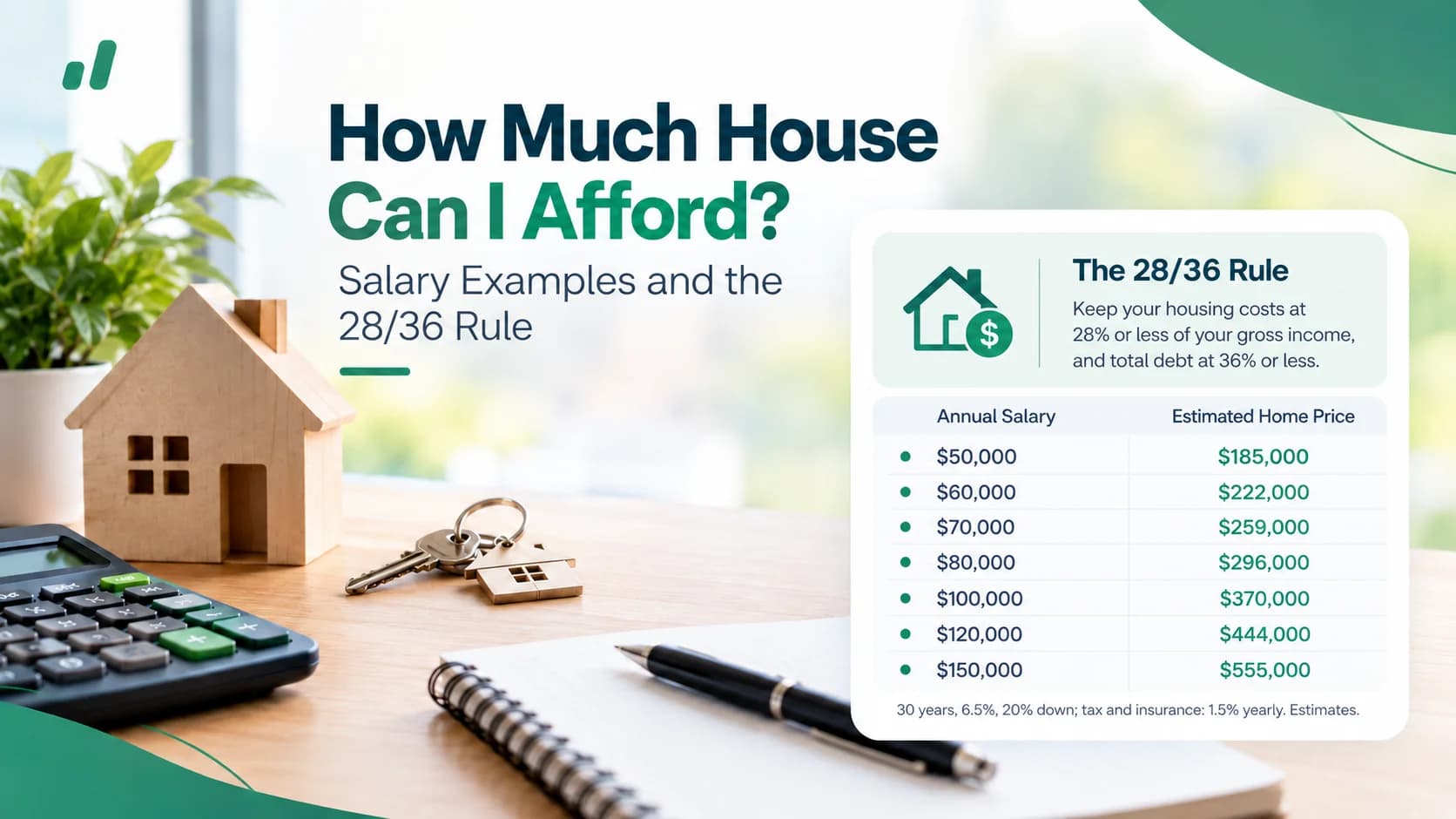
The table shows the maximum monthly housing cost under the 28% rule and the estimated home price it supports. It assumes a 30-year fixed mortgage at 6.5%, a 20% down payment (so no PMI), and property tax plus homeowners insurance of 1.5% of the home price per year. Change any of these and the result changes.
| Annual salary | Gross monthly income | Max housing cost (28%) | Estimated home price | Loan amount (80%) | Principal and interest |
|---|---|---|---|---|---|
| $50,000 | $4,167 | $1,167 | $185,000 | $148,000 | $935 |
| $60,000 | $5,000 | $1,400 | $222,000 | $177,600 | $1,123 |
| $70,000 | $5,833 | $1,633 | $259,000 | $207,200 | $1,310 |
| $80,000 | $6,667 | $1,867 | $296,000 | $236,800 | $1,497 |
| $100,000 | $8,333 | $2,333 | $370,000 | $296,000 | $1,871 |
| $120,000 | $10,000 | $2,800 | $444,000 | $355,200 | $2,245 |
| $150,000 | $12,500 | $3,500 | $555,000 | $444,000 | $2,806 |
Home prices rounded to the nearest $1,000. Assumptions: 6.5% 30-year fixed rate (illustrative, not a current rate), 20% down, 1.5% of price per year for property tax and insurance, no other debts.
Example: How Much House Can I Afford on a $70,000 Salary?
- Gross monthly income: $70,000 ÷ 12 = $5,833.
- 28% housing limit: $5,833 × 0.28 = $1,633 a month.
- At 1.5% a year, tax and insurance on a $259,000 home are about $324 a month, leaving $1,310 for principal and interest.
- $1,310 a month at 6.5% for 30 years pays off a loan of about $207,200. Add a 20% down payment of about $51,800 and the home price is roughly $259,000.
If this buyer also pays $500 a month on other debts, the 36% limit ($2,100) leaves $1,600 for housing, which lowers the price to about $254,000. At $50,000 the same $500 of debt lowers the price from $185,000 to about $159,000, because the back-end limit becomes the tighter one.
How Interest Rates Change the Answer
On a $100,000 salary with the same $2,333 housing budget, the estimated home price is about $403,000 at 5.5%, $370,000 at 6.5% and $341,000 at 7.5%. Every percentage point changes your buying power by roughly 8%, which is why it pays to compare lender quotes.
For the calculation behind these payments, see how to calculate a mortgage payment.
What Lenders Check Before Approving a Mortgage
The 28/36 rule is a planning guide. Lenders make their own decision using several factors:
- Debt-to-income ratio (DTI). For conventional loans sold to Fannie Mae, the maximum total DTI is 36% for manually underwritten loans, up to 45% with strong credit and reserves, and up to 50% for loans approved through its automated system. FHA, VA and other programs have their own rules. For what lenders consider healthy, see what is a good debt-to-income ratio for a mortgage.
- Credit score and history. A higher score usually means a lower rate, which increases how much you can borrow.
- Down payment. Putting down less than 20% on a conventional loan usually means paying private mortgage insurance (PMI), which adds to your monthly cost. Learn how to get rid of PMI once you have enough equity.
- Income stability and savings. Lenders look at employment history and cash reserves left after closing.
Being approved for a larger loan does not mean the payment will be comfortable. Check the payment against your take-home pay, not just your gross income, with our take-home pay calculator.
How Much House Can I Afford in Canada?
Canadian lenders use two ratios instead of 28/36, plus a stress test:
- Gross debt service (GDS): principal, interest, property taxes and heating (plus 50% of condo fees) as a share of gross income. CMHC's limit for insured mortgages is 39%.
- Total debt service (TDS): GDS costs plus all other debt payments. CMHC's limit is 44%.
- Stress test: you must qualify at the greater of your contract rate plus 2 percentage points or 5.25%, even though you pay the contract rate.
- Down payment: at least 5% of the first $500,000, 10% of the portion from $500,000 to $1.5 million, and 20% for homes of $1.5 million or more. With less than 20% down, CMHC mortgage loan insurance is added to the loan; see how much CMHC insurance costs.
Canada Example: $100,000 Household Income
Assume a contract rate of 4.5%, so the qualifying rate is 6.5%. Property tax is $350 a month, heating $100 and other debts $400.
- Gross monthly income: $8,333. GDS limit (39%): $3,250. After tax and heating, $2,800 is left for principal and interest.
- TDS limit (44%): $3,667. After tax, heating and other debts, $2,817 is left, so GDS is the tighter limit.
- $2,800 a month at the 6.5% qualifying rate over 25 years (with Canadian semi-annual compounding) supports a mortgage of about $418,000.
- With 10% down and a 3.10% CMHC premium added to the loan, that is a home price of about $451,000.
The actual payment at the 4.5% contract rate would be about $2,314 a month, lower than the amount used to qualify. That gap is the purpose of the stress test. Try your own numbers in our mortgage calculator using Canada mode, which applies semi-annual compounding and estimates the CMHC premium.
How to Afford More House
- Pay down other debts first. Every $100 of monthly debt you clear frees up room under the back-end limit.
- Save a larger down payment. It lowers the loan amount and can remove PMI or CMHC insurance.
- Improve your credit score before applying to qualify for a lower rate.
- Compare lenders. A rate difference of even half a percentage point changes your budget noticeably.
- Look at total cost, not just price. Lower property taxes, insurance or HOA dues raise the price you can afford for the same monthly budget.
Frequently Asked Questions
How much house can I afford on a $100,000 salary?
Under the 28% rule, a $100,000 salary allows about $2,333 a month for housing. With 20% down, a 6.5% rate and 1.5% a year for tax and insurance, that supports a home of about $370,000. Lower debts, a larger down payment or a lower rate can raise it.
Is the 28/36 rule still realistic?
It is a conservative guide. Many lenders approve higher ratios, and in high-cost areas buyers often spend more than 28% on housing. Staying close to it leaves more room for savings, repairs and emergencies.
Does the 28/36 rule use gross or net income?
Gross income, which is your pay before taxes and deductions. Because take-home pay is lower, it is worth checking that the payment also fits your net budget.
How much do I need for a down payment?
In the US, conventional loans can start at 3% down for some buyers, but less than 20% usually means paying PMI. In Canada, for homes costing less than $1.5 million, the minimum is 5% of the first $500,000 plus 10% of the portion above $500,000. For homes costing $1.5 million or more, the minimum is 20% of the entire purchase price.
What costs should I include besides the mortgage?
Include property tax, homeowners insurance, any mortgage insurance and HOA or condo fees. Budget separately for maintenance, utilities and closing costs.
Sources
Fannie Mae Selling Guide B3-6-02: Debt-to-Income Ratios
CFPB: What is a debt-to-income ratio?
OSFI: Minimum qualifying rate for uninsured mortgages
CMHC: Premium information for homeowner loans
FCAC: How much you need for a down payment
Examples are estimates based on the stated assumptions and are not a loan offer, approval or financial advice. Lenders apply their own rules.