
What Is a Good Debt-to-Income Ratio for a Mortgage?
Last reviewed:
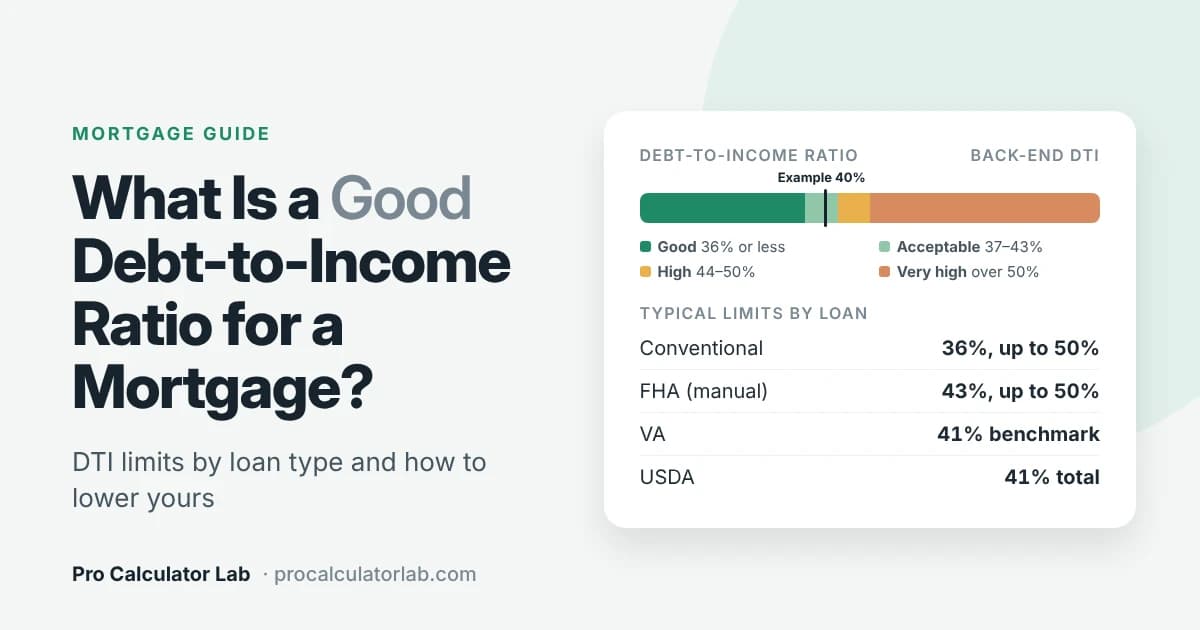
Your debt-to-income ratio, or DTI, is one of the first numbers a mortgage lender checks. It tells them how much of your monthly income is already spoken for before a new house payment is added. There is no single magic number, but there are clear lines lenders work with, and they depend on the type of loan. This guide explains what counts as a good DTI, the limits for conventional, FHA, VA and USDA loans, and practical ways to bring your ratio down before you apply. You can find your own number in a minute with our debt-to-income ratio calculator.
What Is a Good Debt-to-Income Ratio for a Mortgage?
A good debt-to-income ratio for a mortgage is 36% or lower, counting your new housing payment and all other monthly debts. Many lenders will still approve ratios up to 43%, and some loan programs go as high as 50% when you have strong credit, cash reserves or other offsetting strengths.
Lenders care about DTI because it is a simple test of whether you can handle the payment. Someone who already sends half their paycheck to car loans and credit cards has less room for a surprise repair bill or a drop in income.
How DTI Is Calculated
DTI compares your monthly debt payments with your gross monthly income, which is your pay before taxes and deductions.
DTI = total monthly debt payments ÷ gross monthly income × 100What counts as debt: your future mortgage payment (principal, interest, property tax, homeowners insurance, mortgage insurance and HOA dues), plus minimum credit card payments, car loans, student loans, personal loans, and child support or alimony you pay.
What does not count: everyday living costs such as groceries, utilities, phone bills, subscriptions and car insurance. These matter for your budget, but lenders leave them out of DTI.
Example
Maria earns $78,000 a year, or $6,500 a month before tax. The home she wants would cost $1,800 a month including tax and insurance. She also pays $450 on a car loan, $250 on student loans and a $100 credit card minimum.
| Item | Monthly amount |
|---|---|
| New housing payment | $1,800 |
| Car loan | $450 |
| Student loans | $250 |
| Credit card minimum | $100 |
| Total monthly debt | $2,600 |
| Gross monthly income | $6,500 |
| DTI ($2,600 ÷ $6,500) | 40.0% |
Her housing payment alone is 27.7% of income. Adding her other debts brings her to 40%. That is above the 36% comfort zone but within the limits of most loan types, as you will see below.
DTI Ranges: Good, Acceptable and High
These ranges are a practical guide based on where common loan limits fall. They are not official cut-offs, and each lender sets its own rules.
| DTI | How lenders tend to see it | What it means for you |
|---|---|---|
| 36% or less | Good | You meet the baseline for most loans and have room in your budget. Expect the widest choice of lenders and programs. |
| 37% to 43% | Acceptable | Approval is common, particularly for FHA and VA loans. Your credit score and savings start to matter more. |
| 44% to 50% | High | Possible, but usually only with strong credit, cash reserves or an automated underwriting approval. Fewer lenders, less margin for error. |
| Over 50% | Very high | Most conventional loans are off the table. Focus on lowering debt or raising income before applying. |
Maximum DTI by Loan Type
Each mortgage program publishes its own limits. Here is how the main US options compare.
| Loan type | Typical DTI limit | When it can go higher |
|---|---|---|
| Conventional (Fannie Mae) | 36% for manually underwritten loans | Up to 45% with required credit score and reserves; up to 50% when approved through Fannie Mae's automated system (Desktop Underwriter) |
| FHA | 31% housing / 43% total for manual underwriting | Up to 37/47 or 40/50 with documented compensating factors such as cash reserves or residual income; automated approvals can go beyond these |
| VA | 41% benchmark | Higher ratios are allowed with justification, especially when the borrower's residual income is well above VA guidelines |
| USDA | 29% housing / 41% total | Lenders may approve higher ratios case by case |
Two points are worth knowing. First, the higher limits are not automatic; they are granted when the rest of your file is strong. Second, a lender can set stricter rules than the program allows, so the same application can get different answers from different lenders.
Back to Maria: at 40% total and 27.7% housing, she fits the 50% automated limit for conventional loans, FHA's 31/43 manual limits, the VA 41% benchmark and USDA's 29/41 limits. She is close to the edge on VA and USDA, so one new debt could push her over.
Front-End vs Back-End DTI
Lenders often look at two versions of the ratio. Front-end DTI counts only your housing payment. Back-end DTI counts housing plus every other debt, and it is the number most people mean when they say DTI. FHA and USDA set limits on both; conventional loans focus on back-end.
A widely used rule of thumb, the 28/36 rule, suggests keeping front-end DTI at 28% and back-end at 36%. We show what that means for different salaries in how much house can I afford, and explain the two ratios in more depth in front-end vs back-end debt-to-income ratio.
How to Lower Your DTI Before Applying
You can improve DTI from either side: reduce monthly debt payments or increase the income a lender can count. Here is what tends to work, starting with the quickest wins.
Pay off small balances completely. A card with a $3,000 balance and a $100 minimum adds $100 to your monthly debt. Clearing it would drop Maria's DTI from 40% to 38.5%. Closing out a whole payment helps more than chipping away at a large loan.
If Maria paid off her car loan, including through a sale that fully clears the loan, her DTI would fall to about 33%.
Avoid new debt before and during the application. A new car loan or store card can undo months of progress and may need to be re-checked before closing.
Consider a less expensive home or a larger down payment. A smaller loan means a smaller monthly payment, which lowers both front-end and back-end DTI.
Make sure all your income is counted. Lenders can include regular overtime, bonuses, part-time work or a co-borrower's income if it is documented, usually for two years.
Look at income-driven student loan payments if you have federal loans. The monthly payment the lender uses may be lower, but rules differ by loan program, so ask your lender how they will count it.
A quick way to test options is to enter different debt amounts into the DTI calculator and see how far each change moves your ratio.
How Much Mortgage Payment Fits Your DTI?
You can also work backwards. Multiply your gross monthly income by your target DTI, then subtract your other debts. What remains is the most you can spend on housing.
| Target DTI | $6,500 × target | Minus $800 other debts | Maximum housing payment |
|---|---|---|---|
| 36% | $2,340 | −$800 | $1,540 |
| 43% | $2,795 | −$800 | $1,995 |
| 45% | $2,925 | −$800 | $2,125 |
| 50% | $3,250 | −$800 | $2,450 |
To turn that housing budget into a home price, plug it into our mortgage calculator with your rate, down payment, property tax and insurance.
Frequently Asked Questions
Is a 40% debt-to-income ratio good for a mortgage?
It is acceptable rather than ideal. A 40% DTI is within the standard limits for conventional loans approved through automated underwriting, FHA, VA and USDA loans, but it sits close to the VA and USDA benchmarks and leaves less room in your budget. Strong credit and savings help.
What is the highest DTI for a mortgage?
For conventional loans backed by Fannie Mae, the maximum is 50% with an automated approval. FHA manual underwriting allows up to 50% with two compensating factors, and FHA automated approvals can sometimes go higher. Approval at these levels depends on the rest of your application.
Do lenders use gross or net income for DTI?
Gross income, which is your pay before taxes and deductions. That is why a DTI that looks fine to a lender can still feel tight on your actual take-home pay.
Does rent count in DTI when buying a home?
For a primary residence that replaces your current rental home, lenders generally use the new housing payment instead of your current rent. Rental obligations may still count in other situations.
Does DTI affect my credit score?
Not directly. Credit scores do not use your income. However, the balances that raise your DTI, especially credit card balances, can also affect your score through credit utilization.
Sources
Fannie Mae Selling Guide B3-6-02: Debt-to-Income Ratios
HUD Single Family Housing Policy Handbook 4000.1
eCFR: 38 CFR 36.4340, VA underwriting standards
FDIC: USDA Single Family Housing Guaranteed Loan Program summary
CFPB: What is a debt-to-income ratio?
This article is general information, not lending or financial advice. Loan program rules change and lenders apply their own standards; confirm requirements with your lender.