
How Is a Mortgage Payment Calculated? Formula and Example
Last reviewed:
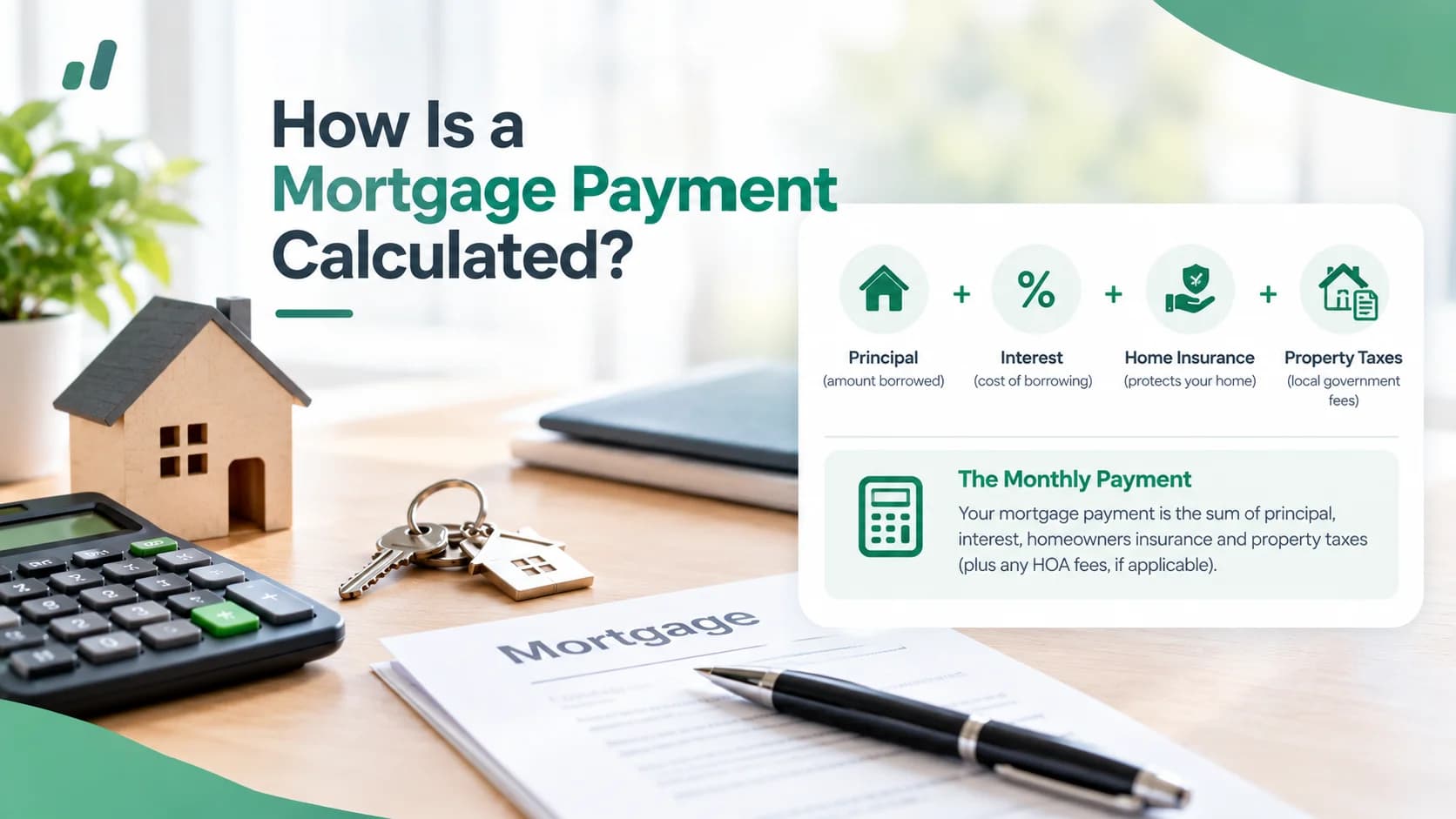
A fixed-rate mortgage payment is calculated with a standard formula that uses three numbers: the amount you borrow, the interest rate and the number of payments. The formula produces one payment amount that stays the same every month and pays the loan off exactly by the end of the term. This guide shows the mortgage payment formula, walks through a full example, explains why early payments are mostly interest, and covers the different method Canadian lenders use. If you just want the answer, our mortgage payment calculator does the math for you.
The Mortgage Payment Formula
The monthly payment on a fixed-rate mortgage is M = P × r(1 + r)^n ÷ [(1 + r)^n − 1], where P is the loan amount, r is the monthly interest rate (the annual rate divided by 12) and n is the total number of monthly payments. The result, M, is your monthly principal and interest payment.
M = P × [ r × (1 + r)^n ] ÷ [ (1 + r)^n − 1 ]| Symbol | Meaning | Example value |
|---|---|---|
| M | Monthly principal and interest payment | What we are solving for |
| P | Principal: the amount you borrow (price minus down payment) | $320,000 |
| r | Monthly interest rate = annual rate ÷ 12 | 6.5% ÷ 12 = 0.0054167 |
| n | Number of monthly payments = years × 12 | 30 × 12 = 360 |
This payment covers principal and interest only. Property tax, homeowners insurance and mortgage insurance are added on top, as explained further down.
Step-by-Step Example: $320,000 at 6.5% for 30 Years
Say you buy a $400,000 home with a 20% down payment of $80,000, so you borrow $320,000 at a fixed 6.5% for 30 years.
- Convert the rate to monthly: 6.5% ÷ 12 = 0.541667% a month, or r = 0.0054167.
- Count the payments: 30 years × 12 = n = 360.
- Work out (1 + r)^n: 1.0054167^360 = 6.9918.
- Top of the fraction: 0.0054167 × 6.9918 = 0.037872.
- Bottom of the fraction: 6.9918 − 1 = 5.9918.
- Divide and multiply by the loan: 0.037872 ÷ 5.9918 = 0.0063207, and $320,000 × 0.0063207 = $2,022.62 a month.
Over 360 payments you would pay $728,142 in total, which is the $320,000 you borrowed plus $408,142 in interest.
Calculate It in Excel or Google Sheets
Spreadsheets have a built-in function. Enter the formula below and it returns $2,022.62 (the minus sign makes the result positive):
=PMT(0.065/12, 360, -320000)How the Rate and Term Change the Payment
| Loan of $320,000 | Monthly payment | Total interest |
|---|---|---|
| 30 years at 5.5% | $1,816.92 | $334,093 |
| 30 years at 6.5% | $2,022.62 | $408,142 |
| 30 years at 7.5% | $2,237.49 | $485,495 |
| 15 years at 6.5% | $2,787.54 | $181,758 |
A 15-year loan costs about $765 more a month than a 30-year loan at the same rate, but saves roughly $226,000 in interest. Rates and terms shown are examples, not current offers.
How Mortgage Interest Is Calculated Each Month
Each month, the lender charges interest on the balance you still owe, then the rest of your payment reduces that balance:
- Interest this month = remaining balance × monthly rate.
- Principal this month = payment − interest.
- New balance = old balance − principal.
In month one of our example, interest is $320,000 × 0.0054167 = $1,733.33, so only $289.28 of the $2,022.62 payment goes to principal. The balance drops to $319,710.72, so month two's interest is slightly lower and a little more goes to principal. This repeating process is called amortization.
Rounding note: these examples use the unrounded formula payment internally and round each displayed figure independently. Subtracting the displayed $1,733.33 interest from the displayed $2,022.62 payment gives $289.29, rather than the $289.28 obtained before rounding. A lender's cent-rounded schedule may therefore differ slightly.
Principal vs Interest Over Time
Because interest is charged on a large balance at first, early payments are mostly interest. As the balance falls, more of each payment goes to principal. Here is how the same $320,000 loan progresses:
| End of year | Remaining balance | Total interest paid so far | Total principal paid so far |
|---|---|---|---|
| 1 | $316,423 | $20,695 | $3,577 |
| 5 | $299,555 | $100,912 | $20,445 |
| 10 | $271,284 | $193,998 | $48,716 |
| 15 | $232,189 | $276,260 | $87,811 |
| 20 | $178,129 | $343,557 | $141,871 |
| 25 | $103,373 | $390,159 | $216,627 |
| 30 | $0 | $408,142 | $320,000 |
Two things stand out. After 10 years you have paid almost $194,000 in interest but only about $49,000 off the loan. And principal does not overtake interest in each payment until about month 233, early in year 20. The last payment is almost all principal: about $2,012 principal and $11 interest.
Our mortgage calculator shows this full payment-by-payment amortization schedule for your own loan.
Paying Extra Toward Principal
Extra payments go straight to principal, so they cut the interest charged in every later month. Adding $200 a month to the example payment pays the loan off in about 23 years and 5 months instead of 30, and saves roughly $105,000 in interest. Check with your lender that extra payments are applied to principal and whether any prepayment limits apply.
What Else Is in Your Monthly Payment (PITI)
The formula gives principal and interest only. Most homeowners pay more each month, often summarised as PITI:
- Principal and interest: the formula result.
- Taxes: property tax, often collected monthly by the lender into an escrow account.
- Insurance: homeowners insurance, also usually paid through escrow.
- Mortgage insurance: PMI on many conventional loans with less than 20% down, or FHA mortgage insurance. Learn how to get rid of PMI once you build equity.
For example, adding $400 a month of property tax and $150 of insurance to the $2,022.62 payment gives a total of $2,572.62. HOA or condo fees are usually paid separately but still belong in your budget. To see what total payment fits your income, read how much house can I afford.
Canada: How Mortgage Payments Are Calculated With Semi-Annual Compounding
Canada's Interest Act requires a blended-payment mortgage to state its interest rate calculated yearly or half-yearly, not in advance. In practice, Canadian fixed-rate mortgages are compounded semi-annually, so the quoted annual rate is converted to an equivalent monthly rate differently:
Monthly rate r = (1 + annual rate ÷ 2)^(1/6) − 1For a 5% fixed rate, r = (1.025)^(1/6) − 1 = 0.41239% a month, compared with 0.41667% if you simply divided by 12. That small difference lowers the payment.
| $400,000 at 5% over 25 years | Monthly payment | Total interest |
|---|---|---|
| Semi-annual compounding (Canada) | $2,326.42 | $297,926 |
| Monthly compounding (US-style) | $2,338.36 | $301,508 |
The Canadian method saves about $12 a month in this example. Canadian borrowers can also choose biweekly or weekly payments; see biweekly vs accelerated biweekly mortgage payments. If your down payment is under 20%, CMHC mortgage insurance is usually added to the loan amount before the payment is calculated; read how much CMHC insurance costs.
Frequently Asked Questions
What is the formula for a monthly mortgage payment?
M = P × r(1 + r)^n ÷ [(1 + r)^n − 1], where P is the loan amount, r is the annual rate divided by 12 and n is the number of monthly payments. It gives the fixed principal and interest payment for the life of the loan.
How much is the payment on a $320,000 mortgage?
At 6.5% for 30 years, the principal and interest payment is $2,022.62 a month. At 5.5% it is $1,816.92, and over 15 years at 6.5% it is $2,787.54. Taxes and insurance are extra.
Why is most of my early payment interest?
Interest is charged on the balance you still owe, which is highest at the start. As you pay down the balance, the interest portion shrinks and the principal portion grows, even though the total payment stays the same.
Does the formula work for adjustable-rate mortgages?
Only for each fixed period. When the rate resets, the payment is recalculated using the new rate, the remaining balance and the remaining term.
Why does my lender's payment differ slightly from the formula?
Lenders may round each month's interest to the cent, adjust the final payment, use a different first-payment date or include escrow and insurance in the quoted figure. Differences of a few cents to a few dollars are normal.
Sources
Justice Laws Website: Interest Act, section 6
CFPB: What is included in a monthly mortgage payment?
Examples are estimates for education only, based on the stated rates and terms, and are not a loan offer or financial advice.