
What Is Taken Out of My Paycheck? Federal Deductions Explained
Last reviewed:
If your paycheck is smaller than your salary suggests, the difference is not random. A handful of federal items come out of almost every US paycheck, and a few more depend on the benefits you sign up for. This guide explains each line, shows how the amounts are worked out with 2026 figures, and walks through a sample pay stub for a $75,000 salary. To see your own numbers, use our take-home pay calculator.
What Is Taken Out of Your Paycheck?
Four kinds of federal deductions come out of a typical US paycheck: federal income tax withholding, Social Security tax of 6.2%, Medicare tax of 1.45%, and any pre-tax deductions you chose, such as 401(k) contributions or health insurance premiums. Depending on where you live and work, state and local income tax and post-tax deductions can also come out.
Social Security and Medicare are often shown together as FICA tax, a combined 7.65% of most wages. Your employer pays a matching 7.65% on top of your pay, but that amount never appears as a deduction on your stub. For the basic difference between what you earn and what you keep, see gross pay vs net pay.
Federal Income Tax Withholding
Federal income tax withholding is an advance payment toward the tax you will owe for the year. Your employer works it out each payday from three things: how much you earn in that pay period, how often you are paid, and the choices on your Form W-4.
How your employer calculates it
Most payroll systems use the IRS percentage method in Publication 15-T. In simple terms:
- Start with taxable wages for the pay period: gross pay minus pre-tax deductions such as a traditional 401(k) and pre-tax health insurance.
- Apply the withholding table for your filing status and pay frequency. The tables build in the 2026 standard deduction ($16,100 for single filers) and the 2026 tax brackets, spread over the year.
- Subtract any credits you listed in Step 3 of your W-4 (such as the child tax credit), divided by the number of paychecks.
- Add any extra withholding you asked for in Step 4(c).
For a single filer paid every two weeks in 2026, no federal income tax is withheld on the first $619 of taxable wages in each paycheck. That is the standard deduction spread across 26 paychecks.
Why withholding is an estimate
Withholding assumes you earn the same amount all year and have no other income or deductions. If you have a second job, freelance income, or a working spouse, too little may be withheld unless you complete Step 2 of the W-4. If you itemize or claim credits, too much may be withheld. Your final tax is settled when you file your return, which is why you may get a refund or owe a balance.
Social Security Tax
Social Security tax is 6.2% of your wages, up to a yearly limit called the wage base. For 2026 the wage base is $184,500, so the most anyone pays through payroll is $11,439 for the year. Pay above the limit is not taxed for Social Security.
Most people never reach the limit, but higher earners will see this line stop partway through the year. For example, on a $250,000 salary paid every two weeks ($9,615.38 per paycheck), $596.15 is withheld for Social Security in each of the first 19 paychecks. The 20th paycheck reaches the limit, so only $112.08 is withheld, and nothing after that. Net pay rises for the rest of the year.
If you change jobs, each employer withholds Social Security up to the limit on its own. If the total from two or more employers is more than $11,439, you can claim the excess back as a credit on your tax return.
Medicare Tax
Medicare tax is 1.45% of all wages, with no yearly limit. Once your wages from one employer pass $200,000 in a calendar year, your employer must also withhold an Additional Medicare Tax of 0.9% on the amount over $200,000, making 2.35% on that portion. Unlike the regular Medicare tax, employers do not pay a matching share of the extra 0.9%.
The $200,000 point is a withholding trigger, not your exact threshold. Married couples filing jointly owe the extra tax on combined wages over $250,000, so you may get some back, or owe more, when you file.
Pre-Tax Deductions: 401(k), Health Insurance and More
Pre-tax deductions come out before income tax is calculated, so they lower the amount of pay that is taxed. Not all of them lower FICA tax, though, and that changes your take-home pay.
| Deduction | Lowers federal income tax? | Lowers Social Security and Medicare? |
|---|---|---|
| Traditional 401(k) or 403(b) | Yes | No |
| Health, dental and vision premiums (Section 125 plan) | Yes | Yes |
| HSA contributions through payroll (Section 125) | Yes | Yes |
| Health FSA and dependent care FSA | Yes | Yes |
| Commuter transit and parking benefits | Yes | Yes |
| Roth 401(k) | No (taken after tax) | No |
Because pre-tax deductions reduce your tax, they cost less in take-home pay than they put aside. In the example below, a $173.08 traditional 401(k) contribution lowers take-home pay by only $135.00, because federal income tax withholding falls by $38.08.
Post-Tax Deductions
Some deductions come out after all taxes have been calculated, so they do not change your tax. Common ones are Roth 401(k) contributions, union dues, supplemental life or disability insurance, charitable payroll giving, and wage garnishments such as child support or a court-ordered debt payment. They reduce your net pay dollar for dollar.
Example: A $75,000 Pay Stub, Line by Line
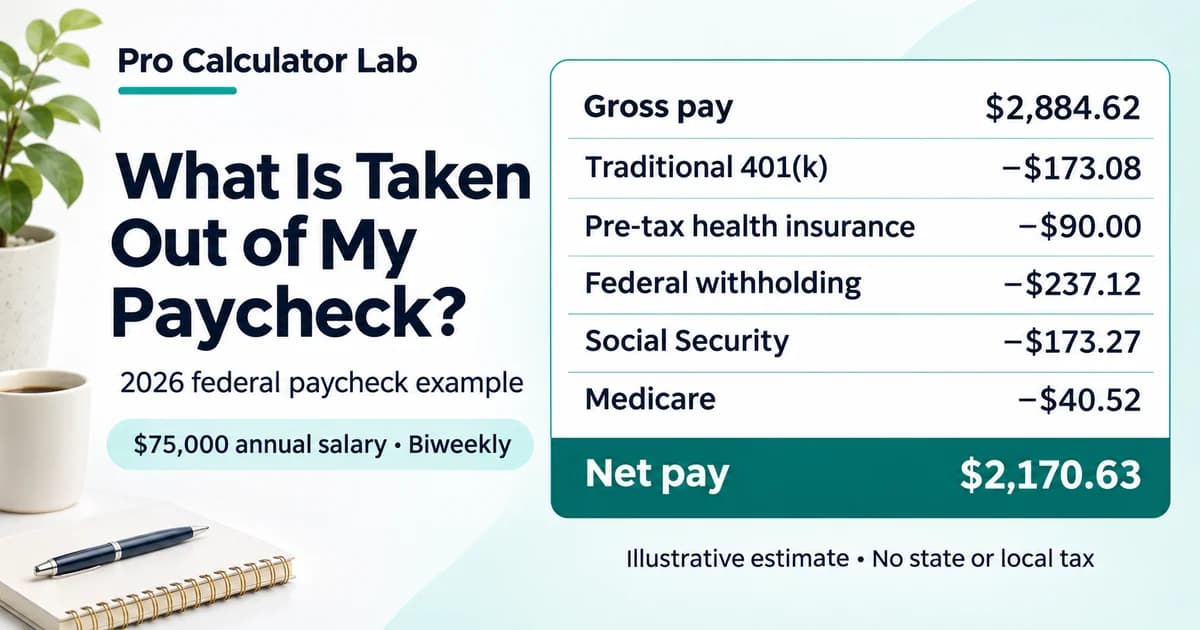
Here is a 2026 biweekly paycheck for a single filer earning $75,000 a year. The employee puts 6% of pay into a traditional 401(k), pays $90 per paycheck for health insurance through a pre-tax plan, has a standard W-4 and lives in a state with no income tax.
| Line on the pay stub | How it is worked out | Per paycheck | Per year |
|---|---|---|---|
| Gross pay | $75,000 ÷ 26 | $2,884.62 | $75,000.00 |
| Traditional 401(k) | 6% of gross pay | −$173.08 | −$4,500.08 |
| Health insurance (pre-tax) | Plan premium | −$90.00 | −$2,340.00 |
| Federal income tax | Pub 15-T table on $2,621.54 | −$237.12 | −$6,165.12 |
| Social Security | 6.2% of $2,794.62 | −$173.27 | −$4,505.02 |
| Medicare | 1.45% of $2,794.62 | −$40.52 | −$1,053.52 |
| Net pay | $2,170.63 | $56,436.38 |
Yearly figures are 26 paychecks; the extra 12 cents of gross pay is rounding.
How the numbers are worked out
- Taxable wages for income tax: $2,884.62 − $173.08 (401(k)) − $90.00 (health) = $2,621.54.
- Withholding: the 2026 biweekly single table charges $223.14 plus 22% of wages over $2,558. That is $223.14 + 22% × $63.54 = $237.12.
- Wages for Social Security and Medicare: $2,884.62 − $90.00 = $2,794.62. The health premium lowers FICA wages; the 401(k) does not.
Net pay is about 75% of gross pay. Federal taxes take about 16%, and the employee's own savings and benefits take about 9%.
Over the year, the $6,165.12 withheld is within a few cents of the tax on this income from the 2026 brackets, so this employee should get little or no refund if nothing else changes.
How Bonuses Are Taxed
Bonuses, commissions and other supplemental wages are often withheld at a flat 22% for federal income tax when they are paid separately from your regular pay. The rate rises to 37% on supplemental pay above $1 million in a year. Social Security and Medicare apply as usual.
On a $5,000 bonus, that means $1,100.00 of federal withholding, $310.00 of Social Security and $72.50 of Medicare, leaving $3,517.50 before any state tax. The 22% is only withholding, not a special tax rate: the bonus is taxed with the rest of your income when you file, so you may get some back or owe a little more.
Pay Stub Codes and What They Mean
| Code on the stub | What it means |
|---|---|
| FED WH, FIT, FWT | Federal income tax withheld |
| OASDI, SS, SOC SEC | Social Security tax (Old-Age, Survivors and Disability Insurance) |
| MED, MEDI, FICA-MED | Medicare tax |
| FICA | Social Security and Medicare combined |
| 401K, 401K PRE | Traditional (pre-tax) 401(k) contribution |
| ROTH 401K | Roth (after-tax) 401(k) contribution |
| SIT, ST WH | State income tax withheld |
| YTD | Year-to-date total since January 1 |
Codes vary by payroll provider. If a line is unclear, your payroll or HR team can tell you what it is.
How to Change What Comes Out of Your Paycheck
- Update your Form W-4 with your employer if you are getting a large refund or owing at tax time. The IRS Tax Withholding Estimator can help you choose the right entries.
- Change your benefit elections during open enrollment or after a qualifying life event.
- Adjust your 401(k) percentage in your plan's portal. Raising a pre-tax contribution lowers your income tax withholding at the same time.
You cannot opt out of Social Security and Medicare on regular wages; they are required for most employees.
Frequently Asked Questions
What percentage of my paycheck goes to taxes?
It depends on your income, filing status and benefits. Social Security and Medicare take 7.65% of most wages. Federal income tax withholding adds anywhere from 0% to over 20%. In the $75,000 example above, federal taxes take about 16% of gross pay.
Why was no federal income tax taken out of my paycheck?
If your taxable wages for the pay period are below the amount covered by the standard deduction ($619 per biweekly paycheck for a single filer in 2026), no federal income tax is withheld. It can also happen if your W-4 claims large credits or you claimed exemption from withholding.
When does Social Security stop coming out of my paycheck?
It stops once your wages from that employer reach $184,500 for 2026. It starts again on January 1.
Is FICA the same as federal income tax?
No. FICA is Social Security and Medicare, which fund those programs. Federal income tax is a separate tax based on your total income for the year, and withholding is an estimate of it.
Do pre-tax deductions lower Social Security and Medicare?
Some do. Health insurance, HSA and FSA contributions through a Section 125 plan lower both income tax and FICA. A traditional 401(k) lowers income tax only.
Sources
IRS Publication 15 (2026), Employer's Tax Guide
IRS Publication 15-T, Federal Income Tax Withholding Methods
IRS Tax Topic 751, Social Security and Medicare withholding rates
IRS Tax Topic 560, Additional Medicare Tax
Examples are estimates for education only and are not tax or payroll advice. Your employer's payroll system, your W-4, your benefit plans and state rules determine your actual paycheck.