
Tax & Paycheck
2026 Federal Tax Brackets and Rates (With Examples)
Facts checked against IRS sources: October 21, 2026
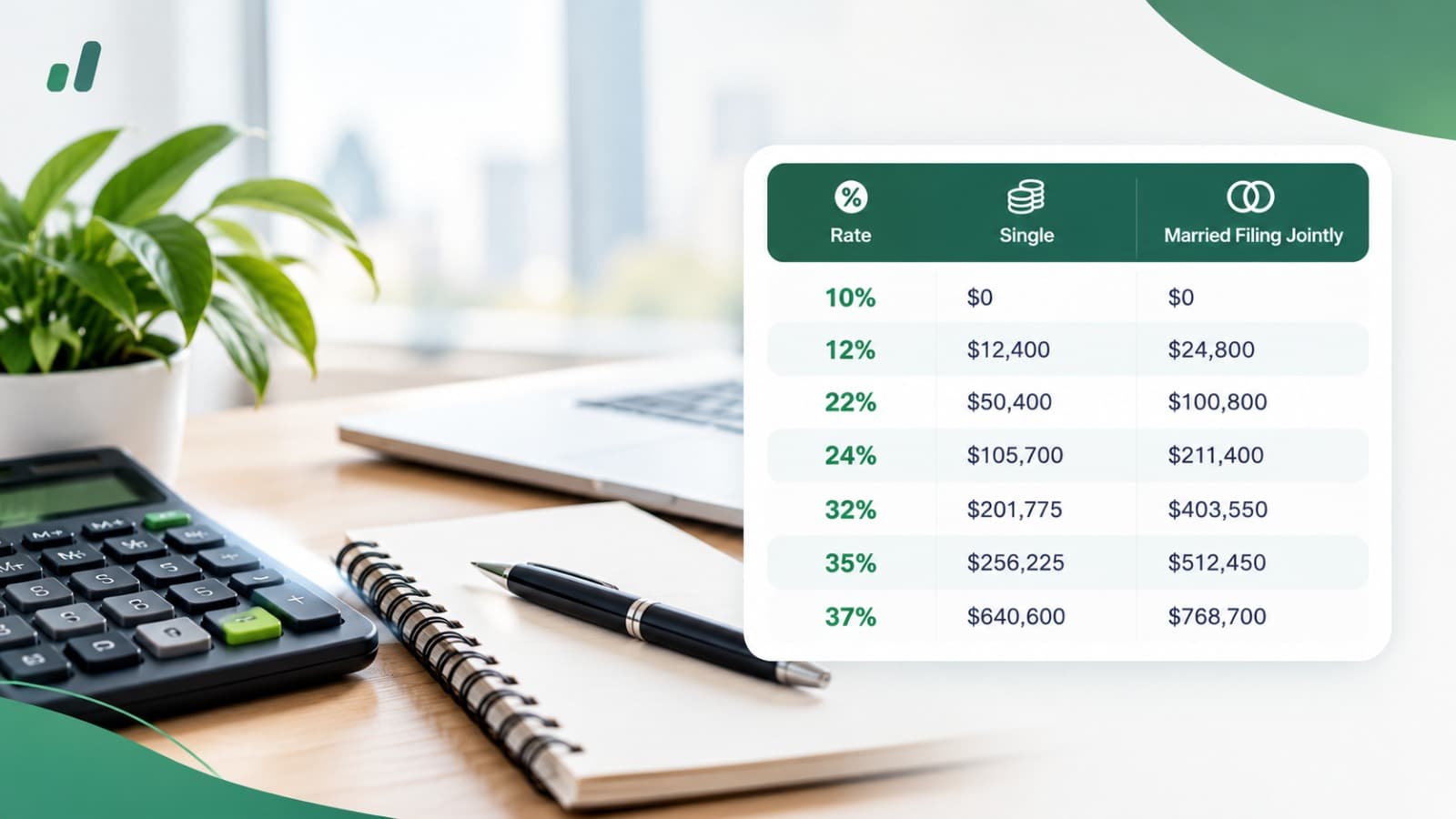
The 2026 tax brackets set the federal income tax rates that apply to income you earn from January 1 to December 31, 2026, which you report on the tax return you file in early 2027. There are still seven rates, from 10% to 37%, but the income ranges for each rate are higher than in 2025 because the IRS adjusts them for inflation. Below you will find the full 2026 federal tax brackets for every filing status covered here, the new standard deduction, and step-by-step examples. To skip the math, enter your numbers in our income tax calculator and get an estimate in seconds.
2026 Federal Tax Brackets at a Glance
For 2026, the IRS keeps seven federal income tax rates: 10%, 12%, 22%, 24%, 32%, 35% and 37%. For a single filer, the 10% rate applies to the first $12,400 of taxable income and the 37% rate applies above $640,600. For married couples filing jointly, those limits are $24,800 and $768,700.
The tables below show the taxable income range for each rate and how the tax is calculated within each bracket. Taxable income is your income after deductions, not your gross salary. Ranges are written as 'over' the previous threshold so cents between whole-dollar amounts are included. These are ordinary-income rate schedules, not the IRS return-filing Tax Table.
2026 Tax Brackets for Single Filers
| Tax rate | Taxable income | Tax owed |
|---|---|---|
| 10% | $0 to $12,400 | 10% of taxable income |
| 12% | Over $12,400 to $50,400 | $1,240 plus 12% of the amount over $12,400 |
| 22% | Over $50,400 to $105,700 | $5,800 plus 22% of the amount over $50,400 |
| 24% | Over $105,700 to $201,775 | $17,966 plus 24% of the amount over $105,700 |
| 32% | Over $201,775 to $256,225 | $41,024 plus 32% of the amount over $201,775 |
| 35% | Over $256,225 to $640,600 | $58,448 plus 35% of the amount over $256,225 |
| 37% | Over $640,600 | $192,979.25 plus 37% of the amount over $640,600 |
2026 Tax Brackets for Married Filing Jointly
| Tax rate | Taxable income | Tax owed |
|---|---|---|
| 10% | $0 to $24,800 | 10% of taxable income |
| 12% | Over $24,800 to $100,800 | $2,480 plus 12% of the amount over $24,800 |
| 22% | Over $100,800 to $211,400 | $11,600 plus 22% of the amount over $100,800 |
| 24% | Over $211,400 to $403,550 | $35,932 plus 24% of the amount over $211,400 |
| 32% | Over $403,550 to $512,450 | $82,048 plus 32% of the amount over $403,550 |
| 35% | Over $512,450 to $768,700 | $116,896 plus 35% of the amount over $512,450 |
| 37% | Over $768,700 | $206,583.50 plus 37% of the amount over $768,700 |
2026 Tax Brackets for Head of Household
| Tax rate | Taxable income | Tax owed |
|---|---|---|
| 10% | $0 to $17,700 | 10% of taxable income |
| 12% | Over $17,700 to $67,450 | $1,770 plus 12% of the amount over $17,700 |
| 22% | Over $67,450 to $105,700 | $7,740 plus 22% of the amount over $67,450 |
| 24% | Over $105,700 to $201,750 | $16,155 plus 24% of the amount over $105,700 |
| 32% | Over $201,750 to $256,200 | $39,207 plus 32% of the amount over $201,750 |
| 35% | Over $256,200 to $640,600 | $56,631 plus 35% of the amount over $256,200 |
| 37% | Over $640,600 | $191,171 plus 37% of the amount over $640,600 |
2026 Tax Brackets for Married Filing Separately
Married filing separately uses the same ranges as single filers up to the 35% bracket, which ends at $384,350 instead of $640,600.
| Tax rate | Taxable income | Tax owed |
|---|---|---|
| 10% | $0 to $12,400 | 10% of taxable income |
| 12% | Over $12,400 to $50,400 | $1,240 plus 12% of the amount over $12,400 |
| 22% | Over $50,400 to $105,700 | $5,800 plus 22% of the amount over $50,400 |
| 24% | Over $105,700 to $201,775 | $17,966 plus 24% of the amount over $105,700 |
| 32% | Over $201,775 to $256,225 | $41,024 plus 32% of the amount over $201,775 |
| 35% | Over $256,225 to $384,350 | $58,448 plus 35% of the amount over $256,225 |
| 37% | Over $384,350 | $103,291.75 plus 37% of the amount over $384,350 |
Source: IRS Revenue Procedure 2025-32. Qualifying surviving spouses use the joint-return rate schedule and basic standard deduction; eligibility has separate IRS rules.
How Tax Brackets Work
The US uses a progressive tax system. Your income is split into layers, and each layer is taxed at its own rate. Only the income inside a bracket is taxed at that bracket's rate.
Considering ordinary federal income tax brackets alone, crossing a bracket threshold does not make all your income subject to the higher rate. Suppose a single filer's taxable income rises from $50,400 to $51,400. The first $50,400 is taxed exactly as before. Only the extra $1,000 falls in the 22% bracket, so the additional bracket tax is $220 and $780 remains before other taxes or benefit changes.
Your marginal tax rate is the rate on your last dollar of taxable income, which is the highest bracket you reach. Your overall rate is lower, because most of your income is taxed at the lower rates first.
Worked Example: Federal Tax on a $75,000 Salary
Here is how the 2026 tax brackets apply to a single filer earning a $75,000 salary who takes the basic standard deduction and has no other income, adjustments, additional deductions or credits.
- Find taxable income. $75,000 salary - $16,100 standard deduction = $58,900 taxable income.
- Apply the 10% rate to the first $12,400: $1,240.
- Apply the 12% rate to the next $38,000 (from $12,400 to $50,400): $4,560.
- Apply the 22% rate to the remaining $8,500 (from $50,400 to $58,900): $1,870.
- Add the layers: $1,240 + $4,560 + $1,870 = $7,670 in estimated federal income tax under the rate schedule.
| Bracket | Income taxed in this bracket | Tax |
|---|---|---|
| 10% | $12,400 | $1,240 |
| 12% | $38,000 | $4,560 |
| 22% | $8,500 | $1,870 |
| Total | $58,900 taxable income | $7,670 |
This filer is in the 22% tax bracket, but only $8,500 of their income is taxed at 22%. Their estimated federal income tax works out to about 10.2% of their $75,000 salary. A filed return may use the IRS Tax Table rather than these exact-income rate-schedule calculations, so the filed amount can differ.
More 2026 Tax Examples by Filing Status
| Filer | Income | Standard deduction | Taxable income | Federal income tax | Marginal rate |
|---|---|---|---|---|---|
| Single | $60,000 | $16,100 | $43,900 | $5,020 | 12% |
| Single | $75,000 | $16,100 | $58,900 | $7,670 | 22% |
| Head of household | $65,000 | $24,150 | $40,850 | $4,548 | 12% |
| Married filing jointly | $120,000 | $32,200 | $87,800 | $10,040 | 12% |
Examples assume wages only, the basic standard deduction and no adjustments, additional deductions or credits. Credits such as the child tax credit reduce the tax owed after these calculations, subject to eligibility and applicable limits.
2026 Standard Deduction
Before the brackets are applied, most people subtract the standard deduction from their income. For 2026 the basic amounts are:
| Filing status | 2026 standard deduction |
|---|---|
| Single or married filing separately | $16,100 |
| Married filing jointly | $32,200 |
| Head of household | $24,150 |
Eligible taxpayers who are 65 or older or blind may receive an additional standard deduction for each qualifying condition: $1,650, increased to $2,050 if unmarried and not a surviving spouse. Age and blindness can each qualify. Dependent and other eligibility rules can limit the basic standard deduction.
Separately, the One Big Beautiful Bill provides an enhanced senior deduction of up to $6,000 per eligible person ($12,000 for a married couple filing jointly if both qualify) for 2025 through 2028. It phases out above $75,000 of modified adjusted gross income ($150,000 for joint filers). Eligible individuals must be 65 or older by the end of the tax year, have a valid Social Security number, and file jointly if married. It is available to eligible itemizers as well as those taking the standard deduction; other IRS conditions apply. The calculator does not automatically determine these additional deductions or eligibility.
You can itemize instead if your eligible deductions, such as mortgage interest, state and local taxes and charitable gifts, add up to more than the standard deduction, subject to the relevant limits. For eligibility and rules, see the IRS standard deduction rules.
Marginal vs Effective Tax Rate
Your marginal tax rate is the rate on your next dollar of taxable income. Here, effective federal income tax rate means estimated federal income tax divided by gross salary; a taxable-income denominator gives a different percentage.
In the $75,000 example, the marginal rate is 22%, but the effective rate is about 10.2% of salary ($7,670 / $75,000), or 13.0% of taxable income ($7,670 / $58,900). The effective rate is what most people mean when they ask what share of their income goes to federal income tax. Effective tax rate vs marginal tax rate compares the overall share with the rate on the next taxable dollar. The Income Tax Calculator divides its estimated tax after entered credits by entered total ordinary income, not taxable income.
How to Estimate Your Own 2026 Federal Tax
- Add up your 2026 income: wages, interest, ordinary dividends, taxable retirement income and other taxable ordinary income.
- Subtract allowed above-the-line deductions, such as eligible deductible IRA or HSA contributions. Do not subtract payroll-excluded contributions again.
- Subtract the standard deduction for your filing status, or your eligible itemized deductions if they are larger. Check additional deductions and eligibility separately.
- Apply the bracket table for your filing status to the result for a rate-schedule estimate.
- Subtract eligible tax credits, respecting their limits, then compare the total with federal withholding and estimated payments. Follow the IRS return instructions for an actual filing.
What the Federal Tax Brackets Do Not Include
- State and local income tax. Most states have their own rates; some have no broad individual income tax.
- Social Security and Medicare. These payroll taxes are separate from income tax.
- Long-term capital gains and qualified dividends. These generally have separate 0%, 15% or 20% rates; special capital gains categories and other taxes can also apply.
- Tax credits. Credits reduce calculated tax subject to eligibility, refundability, phaseouts and other limits.
Our take-home pay calculator estimates supported US federal paycheck deductions, including Social Security and Medicare. State and local taxes are excluded. The Income Tax Calculator also excludes AMT, net investment income tax and self-employment tax, and does not determine filing-status, deduction or credit eligibility.
2026 Tax Brackets: Frequently Asked Questions
When Do the 2026 Tax Brackets Apply?
They apply to income earned from January 1 to December 31, 2026. You use them when you file your 2026 federal tax return, generally due in April 2027, subject to extensions and special rules. Your 2025 return, filed in 2026, uses the 2025 brackets.
Did the Tax Rates Change for 2026?
No. The seven rates, from 10% to 37%, stay the same. What changed is the income range for each rate, which the IRS raised for inflation, and the standard deduction, which rose to $16,100 for single filers and $32,200 for married couples filing jointly.
What Tax Bracket Am I in for 2026?
Subtract your deductions from your income to find your taxable income, then find the range it falls in for your filing status. For example, a single filer with $58,900 of taxable income is in the 22% bracket, while a married couple filing jointly with $87,800 of taxable income is in the 12% bracket.
Does Moving Into a Higher Tax Bracket Reduce My Take-Home Pay?
Not because of the ordinary federal income tax brackets alone. Only income above the threshold is taxed at the higher rate. A $1,000 increase in taxable income crossing from the 12% into the 22% bracket adds at most $220 of bracket tax, leaving at least $780 before other taxes or benefit changes. Actual take-home pay can also be affected by credits, phaseouts, payroll taxes and other rules.
Are the 2026 Brackets the Same for Every Filing Status?
The rates are the same, but the income ranges differ. Married filing jointly ranges are generally double the single ranges, head of household ranges sit between the two, and married filing separately matches single except in the 35% and 37% brackets. Qualifying surviving spouses use the joint-return rate schedule when eligible.
Sources
This article is for general information and is not tax, legal or financial advice. Tax rules can change; check IRS guidance or a qualified tax professional for your situation.