
Gross Pay vs Net Pay: What's the Difference?
Last reviewed:
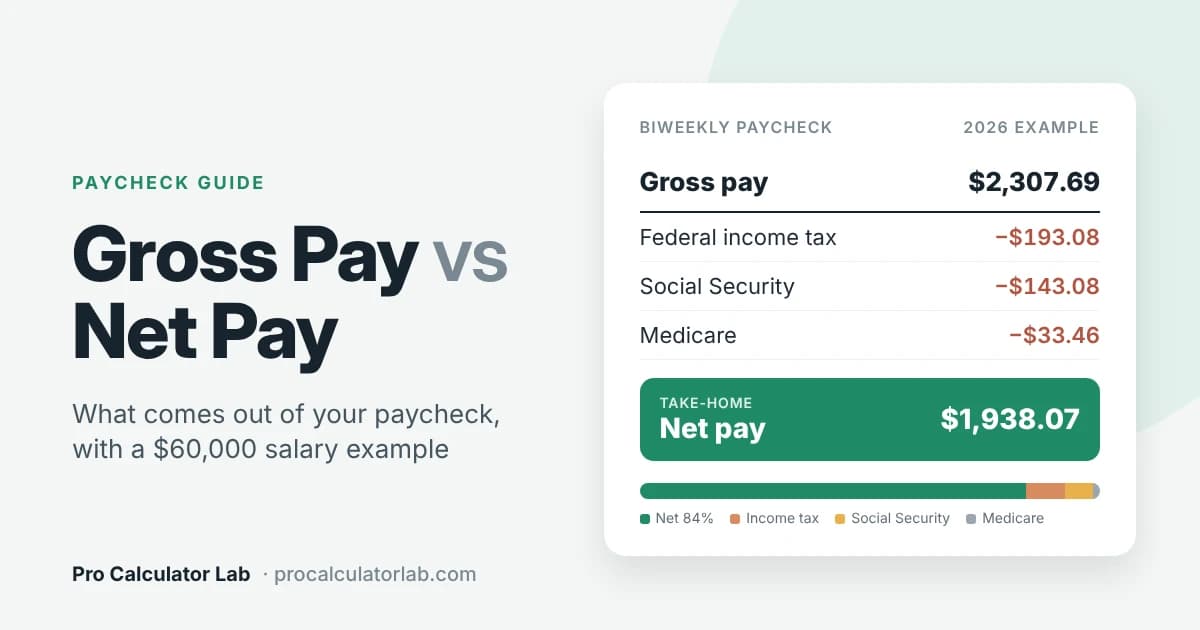
Gross pay is the total amount you earn before anything is taken out. Net pay is what is left after taxes and deductions, the amount that actually lands in your bank account. The gap between the two can be bigger than people expect, so knowing what is deducted helps you budget, compare job offers and spot mistakes on your pay stub. Below, we define both terms, list the most common deductions, and walk through a $60,000 salary example. To see your own numbers, try our take-home pay calculator.
What Is Gross Pay?
Gross pay is your total earnings for a pay period before any taxes or deductions are taken out. For salaried employees it is the annual salary divided by the number of paychecks; for hourly workers it is the hourly rate multiplied by hours worked, plus any overtime, bonuses, tips or commissions.
Salaried: $60,000 a year paid biweekly (26 paychecks) = $2,307.69 gross per paycheck.
Hourly: $25 an hour × 80 hours in a two-week period = $2,000 gross per paycheck.
Gross pay is the figure on job offers, and it is what lenders and landlords usually ask for. Annual gross pay is also sometimes called gross income. To convert an hourly wage to a yearly figure, see our hourly to salary guide.
What Is Net Pay?
Net pay, also called take-home pay, is the amount you actually receive after your employer withholds taxes and other deductions. It is the number you should build your monthly budget around.
Net pay = Gross pay − Taxes − Pre-tax deductions − Post-tax deductionsYour net pay can change from one paycheck to the next if your hours, benefits, tax withholding or retirement contributions change.
What Is Deducted From Gross Pay?
Most US paychecks have three types of deductions. The first two are required; the third depends on your choices and your employer's benefits.
1. Federal payroll taxes (FICA)
Social Security: 6.2% of wages, up to the 2026 wage base of $184,500. Earnings above that are not taxed for Social Security.
Medicare: 1.45% of all wages, with no cap. Employers also withhold an extra 0.9% Additional Medicare Tax on wages above $200,000 in a calendar year.
2. Income tax withholding
Federal income tax: based on your Form W-4 and the IRS withholding tables. The more you earn, the higher the share withheld. See the 2026 federal tax brackets for how the rates work.
State and local income tax: depends on where you live and work. Some states have no income tax.
3. Benefits and other deductions
Pre-tax deductions come out before income tax is calculated, so they lower your taxable income. Examples are traditional 401(k) contributions and, under many employer plans, health insurance premiums.
Post-tax deductions come out after taxes. Examples are Roth 401(k) contributions, some insurance premiums, union dues and wage garnishments.
For a closer look at every line on a pay stub, read what is taken out of my paycheck.
Example: Gross vs Net Pay on a $60,000 Salary
Here is what a single filer earning $60,000 a year, paid biweekly, would see on a 2026 paycheck. The example assumes the standard deduction, a standard Form W-4, no state income tax and no benefits deductions.
| Line on the paycheck | Per paycheck (biweekly) | Per year |
|---|---|---|
| Gross pay | $2,307.69 | $60,000.00 |
| Federal income tax (estimate) | −$193.08 | −$5,020.00 |
| Social Security (6.2%) | −$143.08 | −$3,720.00 |
| Medicare (1.45%) | −$33.46 | −$870.00 |
| Net pay (take-home) | $1,938.07 | $50,390.00 |
In this example, net pay is about 84% of gross pay. Federal income tax is estimated from the 2026 brackets: $60,000 minus the $16,100 standard deduction leaves $43,900 of taxable income, which is taxed at $5,020 for the year. Actual withholding depends on your W-4 and can differ slightly from your final tax.
What Changes If You Contribute to a 401(k)?
Now suppose the same employee puts 5% of pay ($3,000 a year, or $115.38 per paycheck) into a traditional 401(k). Because it is a pre-tax deduction, it reduces taxable income for federal income tax, but not for Social Security and Medicare.
| Line on the paycheck | Per paycheck | Per year |
|---|---|---|
| Gross pay | $2,307.69 | $60,000.00 |
| 401(k) contribution (5%) | −$115.38 | −$3,000.00 |
| Federal income tax (estimate) | −$179.23 | −$4,660.00 |
| Social Security (6.2%) | −$143.08 | −$3,720.00 |
| Medicare (1.45%) | −$33.46 | −$870.00 |
| Net pay (take-home) | $1,836.54 | $47,750.00 |
Saving $3,000 for retirement lowers take-home pay by only $2,640 for the year, because federal income tax falls by $360. That is the main benefit of pre-tax deductions.
Figures are rounded to the cent; per-paycheck amounts can differ by a cent from the annual total divided by 26.
How to Calculate Your Net Pay
Start with gross pay for the pay period.
Subtract pre-tax deductions such as traditional 401(k) contributions.
Subtract federal income tax withholding based on your W-4.
Subtract Social Security (6.2%) and Medicare (1.45%) on your FICA wages.
Subtract state and local income tax, if any.
Subtract post-tax deductions such as Roth contributions or union dues. What is left is your net pay.
Where to Find Gross and Net Pay on Your Pay Stub
Every pay stub shows both figures, though the labels vary by employer:
Gross pay may be labelled 'Gross', 'Total earnings' or 'Gross wages', usually near the top with your hours and rate.
Deductions are listed in a separate section, often split into taxes (federal, state, Social Security or OASDI, Medicare) and benefits or other deductions.
Net pay may be labelled 'Net pay', 'Take-home pay' or 'Direct deposit amount', usually at the bottom.
Year-to-date (YTD) columns show totals since January 1. Check them to see when you reach the Social Security wage base.
Compare a few stubs each year. Sudden changes in net pay without a raise or benefits change can point to a W-4 change or a payroll error.
Gross vs Net Pay: Frequently Asked Questions
Is gross pay before or after taxes?
Before. Gross pay is your total earnings before any taxes or deductions. Net pay is the amount after taxes and deductions.
What percentage of gross pay is net pay?
It varies with income, location and benefits. In our $60,000 example with no state tax or benefits, net pay is about 84% of gross.
Should I use gross or net pay for budgeting?
Use net pay for your monthly budget because it is the money you actually receive. Lenders often use gross pay for ratios such as debt-to-income, so it helps to know both.
Why is my net pay different from last month?
Common reasons include a different number of hours, overtime, a bonus taxed at a different withholding rate, a change to your W-4 or benefits, or reaching the Social Security wage base later in the year.
Is gross income the same as gross pay?
For most employees, gross income for the year is the total of all gross pay plus any other income such as interest or freelance work. Gross pay usually refers to one pay period.
Sources
IRS Tax Topic 751: Social Security and Medicare withholding rates
SSA: Contribution and benefit base
IRS Revenue Procedure 2025-32 (2026 tax brackets and standard deduction)
IRS: Publication 15-T, Federal Income Tax Withholding Methods
Examples are estimates for education only and are not tax or payroll advice. Your employer's payroll system, your W-4 and state rules determine your actual paycheck.