
GST vs HST in Canada: What's the Difference? (2026)
Last reviewed:
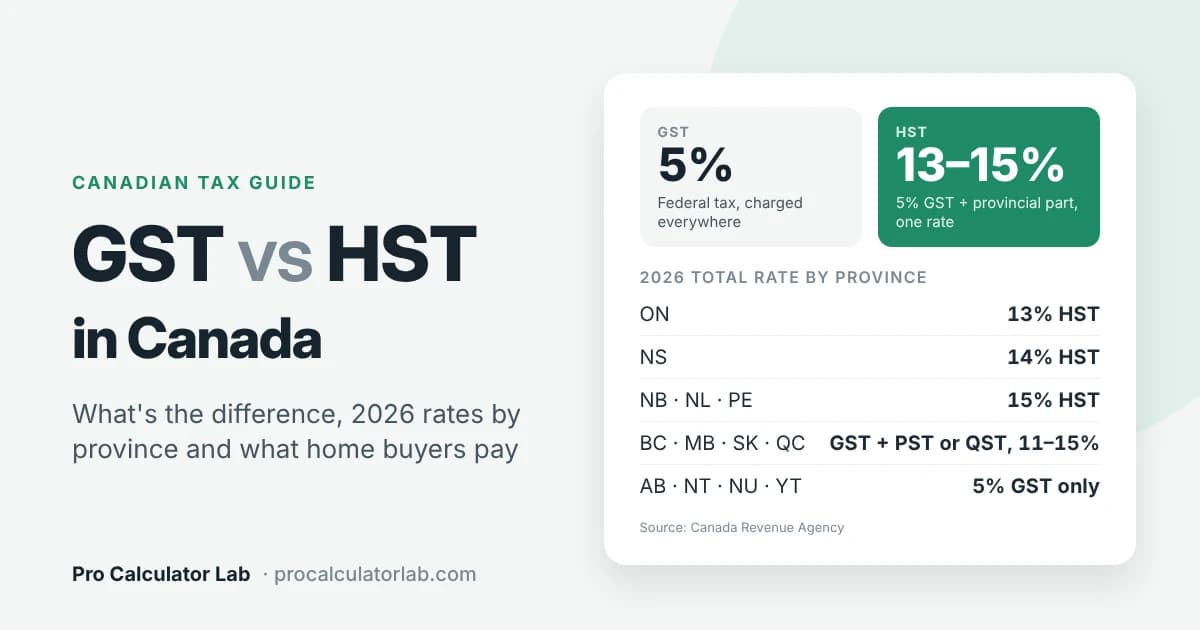
If you have ever bought something in Ontario and then in Alberta, you have seen the difference on your receipt: 13% HST in one, 5% GST in the other. Both are sales taxes, and both include the same federal tax, but they are collected differently depending on your province. The difference matters more than usual when you buy a home, because GST or HST can apply to a newly built house and to many of the services around the purchase. This guide explains how GST and HST work, lists the 2026 rates for every province and territory, and shows how to calculate the tax yourself. For quick totals, use our GST/HST calculator.
What Is the Difference Between GST and HST?
GST is a 5% federal sales tax that applies everywhere in Canada. HST is a single harmonized tax that combines the 5% GST with a provincial sales tax, used in five provinces. In an HST province you pay one combined rate, such as 13% in Ontario, instead of GST plus a separate provincial tax.
For shoppers, the practical difference is simple: you pay one line of tax in an HST province and up to two lines elsewhere. For businesses, HST is filed as one tax with the Canada Revenue Agency, while separate provincial taxes are often filed with the province.
What Is GST?
The Goods and Services Tax is a 5% federal tax on most goods and services sold in Canada. Some items are zero-rated, which means the tax rate is 0%; basic groceries and prescription drugs are common examples. Others are exempt, such as most residential rent and the sale of most used homes.
In Alberta, the three territories and any province without HST, GST is charged as its own line on your receipt.
What Is HST?
The Harmonized Sales Tax replaces GST and the provincial sales tax with one combined rate in participating provinces. The federal part is always 5%, and the province sets the rest. That is why the total differs: Ontario's provincial part is 8%, Nova Scotia's is 9% (after it dropped by one point on April 1, 2025), and New Brunswick, Newfoundland and Labrador, and Prince Edward Island each use 10%.
HST generally applies to the same goods and services as GST, although provinces can offer point-of-sale rebates on certain items, such as children's clothing or books, for their portion of the tax.
PST and QST: Where Provinces Add Their Own Tax
Four provinces keep a separate provincial tax alongside the 5% GST:
British Columbia: 7% PST, for a combined 12%.
Manitoba: 7% retail sales tax, for a combined 12%.
Saskatchewan: 6% PST, for a combined 11%.
Quebec: 9.975% QST, for a combined 14.975%. The QST is administered by Revenu Québec.
Because these provincial taxes have their own rules, the list of taxable items can differ from GST. A product might carry GST but no PST, or the reverse.
2026 Sales Tax Rates by Province and Territory
| Province or territory | Tax type | Federal | Provincial | Total rate |
|---|---|---|---|---|
| Alberta | GST | 5% | — | 5% |
| British Columbia | GST + PST | 5% | 7% | 12% |
| Manitoba | GST + RST | 5% | 7% | 12% |
| New Brunswick | HST | 5% | 10% | 15% |
| Newfoundland and Labrador | HST | 5% | 10% | 15% |
| Northwest Territories | GST | 5% | — | 5% |
| Nova Scotia | HST | 5% | 9% | 14% |
| Nunavut | GST | 5% | — | 5% |
| Ontario | HST | 5% | 8% | 13% |
| Prince Edward Island | HST | 5% | 10% | 15% |
| Quebec | GST + QST | 5% | 9.975% | 14.975% |
| Saskatchewan | GST + PST | 5% | 6% | 11% |
| Yukon | GST | 5% | — | 5% |
Source: Canada Revenue Agency, rates in effect October 2026. Rates can change; Nova Scotia's last change took effect April 1, 2025. For notes on each province, see sales tax rates in Canada by province.
How to Calculate GST and HST
The math is the same for both taxes; only the rate changes.
Tax = price × rateTotal = price + taxPre-tax price (from a tax-included total) = total ÷ (1 + rate)Ontario, adding HST: a $1,500 legal bill × 13% = $195 HST, for a total of $1,695.
Alberta, adding GST: the same $1,500 bill × 5% = $75 GST, for a total of $1,575.
Quebec, two taxes: $1,000 × 5% GST = $50, plus $1,000 × 9.975% QST = $99.75, for a total of $1,149.75.
Removing HST from a total: an Ontario receipt of $1,130 ÷ 1.13 = $1,000 before tax, so the HST was $130. Our guide to reverse sales tax walks through more examples.
GST and HST When You Buy a Home
This is where the tax can run into tens of thousands of dollars, so it is worth knowing the rules before you sign.
Resale homes are usually exempt
When you buy a used home from an individual who lived in it, GST or HST normally does not apply to the purchase price. The Canada Revenue Agency treats most of these sales as exempt because the seller is not a builder.
New homes are taxable
A newly built or substantially renovated home is taxable. In Alberta that means 5% GST; in Ontario, 13% HST. Builders often quote prices that already include the tax and assign the available rebates to themselves, so read the agreement carefully to see whether the price is 'tax included' and who receives the rebate.
Rebates that can reduce the tax on a new home
First-Time Home Buyers' GST rebate: eligible first-time buyers can recover the full GST, or the federal 5% part of HST, up to $50,000 on new homes priced up to $1 million. The rebate shrinks evenly between $1 million and $1.5 million; at $1.25 million it is 50%, or up to $25,000. It became law on March 12, 2026. Builder purchase agreements must generally be entered into on or after March 20, 2025 and before 2031. Construction must begin before 2031, be substantially completed before 2036, and ownership must transfer before 2036. Buyers must be at least 18 and Canadian citizens or permanent residents, must intend to use the home as their primary residence and be the first individual to occupy it after completion. The buyer must not have lived in a home owned by them or their spouse or common-law partner as their primary residence in the relevant calendar year or previous four calendar years; neither partner may previously have received this rebate. For owner-built homes, construction must begin on or after March 20, 2025 and before 2031, with substantial completion and first occupancy before 2036. Different timing rules apply to co-op shares and homes on leased land; check the CRA's eligibility criteria.
GST/HST new housing rebate: buyers who are not first-time buyers may recover 36% of the GST or federal part of the HST, up to $6,300, on homes up to $350,000. It phases out by $450,000.
Provincial rebates: Ontario's existing new housing rebate is up to $24,000. The Ontario enhanced new housing rebate (ENHR), together with that existing rebate, can provide eligible individuals with combined relief of up to $80,000 of the 8% provincial HST. For builder purchases, agreements must generally be signed from April 1, 2026 through March 31, 2027; construction must begin by December 31, 2028, be substantially completed by December 31, 2031, and HST must become payable by December 31, 2032. The home must be acquired for the buyer's or a relation's primary residence. Full provincial relief applies up to $1 million, a flat $80,000 applies above $1 million through $1.5 million, and relief phases down above $1.5 million to below $1.85 million. Owner-built homes have different deadlines: construction must begin April 1, 2026–March 31, 2027 and be substantially completed before 2030. Other eligibility conditions and anti-avoidance rules apply. A separate Ontario new home affordability payment may provide additional relief, reduced by federal housing rebates; do not assume these programs can be stacked without adjustment.
For example, an eligible first-time buyer purchasing a new $800,000 home in Alberta would owe $40,000 in GST before rebates, and the federal first-time buyer rebate could recover all of it. The same tax-exclusive price in Ontario carries $104,000 in HST: $40,000 federal and $64,000 provincial. If the purchaser meets the federal first-time buyer rules and Ontario ENHR conditions, including the qualifying agreement and construction dates, the federal rebate could cover $40,000 and the combined Ontario provincial rebates could cover $64,000. That could relieve the full $104,000, but not every buyer or transaction qualifies; builder pricing and rebate assignments must also be checked.
Services around the purchase
Even on a resale home, many services are taxable. Legal fees, home inspections and appraisals usually have GST or HST added, and so does the real estate commission, which the seller normally pays. CMHC mortgage insurance is not subject to GST or HST, but Ontario, Quebec and Saskatchewan charge provincial sales tax on the premium, and that tax must be paid in cash at closing rather than added to the mortgage. See how much CMHC insurance costs, and estimate your payment with our mortgage calculator.
Frequently Asked Questions
Which provinces use HST?
Ontario, Nova Scotia, New Brunswick, Newfoundland and Labrador, and Prince Edward Island. Every other province and territory charges the 5% GST, with or without a separate provincial tax.
Is HST higher than GST?
Yes, because HST includes the 5% GST plus a provincial portion. But the total tax can be similar to provinces that charge GST and PST separately. Quebec's combined 14.975%, for instance, is higher than Ontario's 13% HST.
Do I pay GST or HST on a resale home?
Usually not on the purchase price, since sales of used owner-occupied homes are generally exempt. You will still pay GST or HST on taxable services such as legal fees and inspections.
Do I charge GST or HST if I sell to another province?
Businesses generally charge the rate of the province where the goods or services are delivered, not where the business is located. Registered businesses should check the CRA's place-of-supply rules.
Is the first-time buyer GST rebate available on resale homes?
No. It applies to new or substantially renovated homes bought from a builder, owner-built homes and certain co-op shares, because resale homes do not normally carry GST in the first place.
Sources
CRA: GST/HST calculator (and rates)
CRA: Sales by individuals of owner-occupied homes (GI-004)
CRA: GST/HST new housing rebate
CRA: RC4028 GST/HST New Housing Rebate guide
CRA: First-time home buyers' (FTHB) GST/HST rebate
Finance Canada: GST relief for first-time home buyers on new homes
CMHC: Premium information for homeowner loans
CRA: Ontario enhanced new housing rebate, current eligibility and relief
CRA: Federal first-time home buyers' rebate eligibility
This article is general information, not tax or legal advice. Eligibility for housing rebates depends on your situation; confirm with the CRA, your province or a tax professional before relying on a rebate.