
How to Calculate Reverse Sales Tax (Step-by-Step)
Last reviewed:
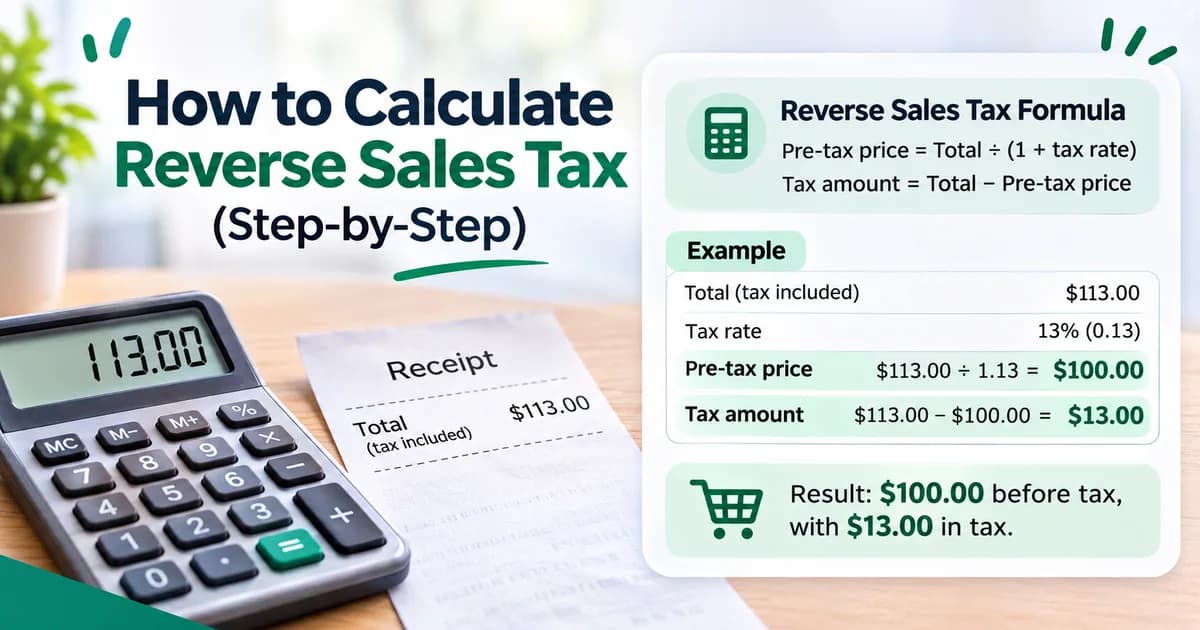
Sometimes you only know the total you paid and need to work out how much of it was tax. Maybe you are filing an expense report, checking a receipt, setting a tax-included price for your shop, or claiming tax credits on business purchases. Working backwards like this is called reverse sales tax, and it takes one division, not a guess. This guide shows the formula, walks through US and Canadian examples step by step, and points out the mistake that trips up most people. If you would rather skip the math, our reverse sales tax calculator does it in seconds.
What Is Reverse Sales Tax?
Reverse sales tax is the process of finding the original price before tax from a total that already includes tax. You divide the tax-included total by one plus the tax rate written as a decimal. The result is the pre-tax price, and subtracting it from the total gives you the amount of tax.
It is the same calculation whether the tax is US state and local sales tax, Canada's GST or HST, or a combined GST and PST rate. Only the rate changes. Add the rates only when both taxes apply to the same pre-tax amount. If items on the receipt are taxed differently, calculate each group separately or use the tax amounts shown on the receipt.
The Reverse Sales Tax Formula
Pre-tax price = Total ÷ (1 + tax rate)
Sales tax     = Total − Pre-tax price
Write the tax rate as a decimal before you add 1: 13% becomes 0.13, so you divide by 1.13. A rate of 8.25% becomes 0.0825, so you divide by 1.0825.
Why divide instead of subtract? When tax is added, the store multiplies the price by (1 + rate). To undo multiplication you divide by the same number. Subtracting a percentage of the total does not undo it, because the tax was calculated on the smaller, pre-tax price.
Step-by-Step Example
You have a receipt for $108.25, and the combined sales tax rate where you shopped is 8.25%.
- Convert the rate to a decimal: 8.25% ÷ 100 = 0.0825.
- Add 1: 1 + 0.0825 = 1.0825.
- Divide the total: $108.25 ÷ 1.0825 = $100.00. That is the price before tax.
- Find the tax: $108.25 − $100.00 = $8.25.
- Check your answer: $100.00 × 8.25% = $8.25, and $100.00 + $8.25 = $108.25. It matches.
More examples
| Total paid | Tax rate | Divide by | Pre-tax price | Tax included |
|---|---|---|---|---|
| $105.00 | 5% (GST only, e.g., Alberta) | 1.05 | $100.00 | $5.00 |
| $112.00 | 12% (GST + PST, British Columbia) | 1.12 | $100.00 | $12.00 |
| $56.50 | 13% (HST, Ontario) | 1.13 | $50.00 | $6.50 |
| $1,695.00 | 13% (HST, Ontario) | 1.13 | $1,500.00 | $195.00 |
| $49.99 | 13% (HST, Ontario) | 1.13 | $44.24 | $5.75 |
| $86.24 | 7.25% (example US rate) | 1.0725 | $80.41 | $5.83 |
Pre-tax prices are rounded to the nearest cent.
How to Reverse GST and HST in Canada
In the five HST provinces, you only need one rate: 13% in Ontario, 14% in Nova Scotia and 15% in New Brunswick, Newfoundland and Labrador, and Prince Edward Island. In Alberta and the territories, use the 5% GST.
Add the rates only when both taxes apply to the same pre-tax amount. If items on the receipt are taxed differently, calculate each group separately or use the tax amounts shown on the receipt.
- British Columbia and Manitoba: 5% + 7% = 12%, so divide by 1.12.
- Saskatchewan: 5% + 6% = 11%, so divide by 1.11.
- Quebec: 5% + 9.975% = 14.975%, so divide by 1.14975.
If you need each tax separately, find the pre-tax price first, then apply each rate to it. A Quebec total of $1,149.75 ÷ 1.14975 = $1,000.00 before tax, which splits into $50.00 GST and $99.75 QST. For a full rate table and the difference between the taxes, see GST vs HST in Canada and sales tax rates in Canada by province.
Common Mistakes to Avoid
Multiplying the total by the tax rate
This is the most common error. On a $113.00 Ontario receipt, $113.00 × 13% = $14.69, which would suggest a pre-tax price of $98.31. The real answer is $113.00 ÷ 1.13 = $100.00, with $13.00 of tax. The mistake overstates the tax by $1.69, and the gap grows with larger amounts.
Forgetting to add 1 to the rate
Dividing $113.00 by 0.13 gives $869.23, which is clearly wrong. Always divide by 1 plus the rate.
Using the wrong rate
Sales tax depends on where the sale takes place, and US rates often combine state, county and city taxes. Check the rate printed on the receipt if there is one. In Canada, businesses generally charge the rate of the province where the item is delivered.
Reversing a total that includes untaxed items
If a receipt mixes taxed and tax-free items (for example, basic groceries and household goods), reverse only the taxed portion. Otherwise the tax you calculate will be too high.
Expecting the cents to always match
Because tax is rounded to the cent, a reversed price can be one cent off when you run it forward again, especially on small amounts. A $1.00 Ontario total reverses to $0.88 plus $0.12 tax, but $0.88 × 1.13 rounds to $0.99. Use the receipt's tax line if it shows one.
Reverse Sales Tax in Excel or Google Sheets
Put the total in cell A2 and the tax rate as a percentage in B2 (for example, 13%). Then use:
Pre-tax price:  =ROUND(A2/(1+B2), 2)
Tax amount:     =A2-ROUND(A2/(1+B2), 2)
Copy the formulas down the column to reverse a whole list of receipts at once.
When You Might Need to Reverse Sales Tax
- Expense reports and reimbursements that ask for the pre-tax amount and the tax separately.
- Business bookkeeping, where a business registered for GST/HST may be able to claim the tax portion of eligible purchases as input tax credits.
- Pricing in tax-included markets, such as setting a round shelf price of $20.00 and working out the price before tax.
- Checking receipts to confirm you were charged the correct rate.
Frequently Asked Questions
How do I find the price before tax?
Divide the total by 1 plus the tax rate as a decimal. With 13% tax, divide by 1.13; with 5% tax, divide by 1.05. The result is the pre-tax price.
How much tax is included in $100?
It depends on the rate. At 13% HST, $100 ÷ 1.13 = $88.50 before tax, so $11.50 is tax. At 5% GST, $100 ÷ 1.05 = $95.24, so $4.76 is tax.
Can I just subtract the tax percentage from the total?
No. Subtracting 13% of the total removes too much, because the tax was calculated on the lower pre-tax price. Divide by 1.13 instead.
How do I reverse two taxes, like GST and PST?
Add the rates only when both taxes apply to the same pre-tax amount. If items on the receipt are taxed differently, calculate each group separately or use the tax amounts shown on the receipt. When the rates can be combined, divide by 1 plus the combined rate. Then apply each original rate to the pre-tax price if you need the separate amounts.
Is reverse sales tax the same as a tax refund?
No. Reverse sales tax is just a calculation that tells you how much tax a total contains. Whether you can get that tax back depends on your situation, such as a registered business claiming input tax credits.
Sources
CRA: GST/HST calculator (and rates)
Revenu Québec: QST and GST/HST
Examples are for general information and are not tax advice. Tax rates and taxable items vary by location; confirm the rate that applies to your purchase.