
Front-End vs Back-End Debt-to-Income Ratio Explained
Last reviewed:
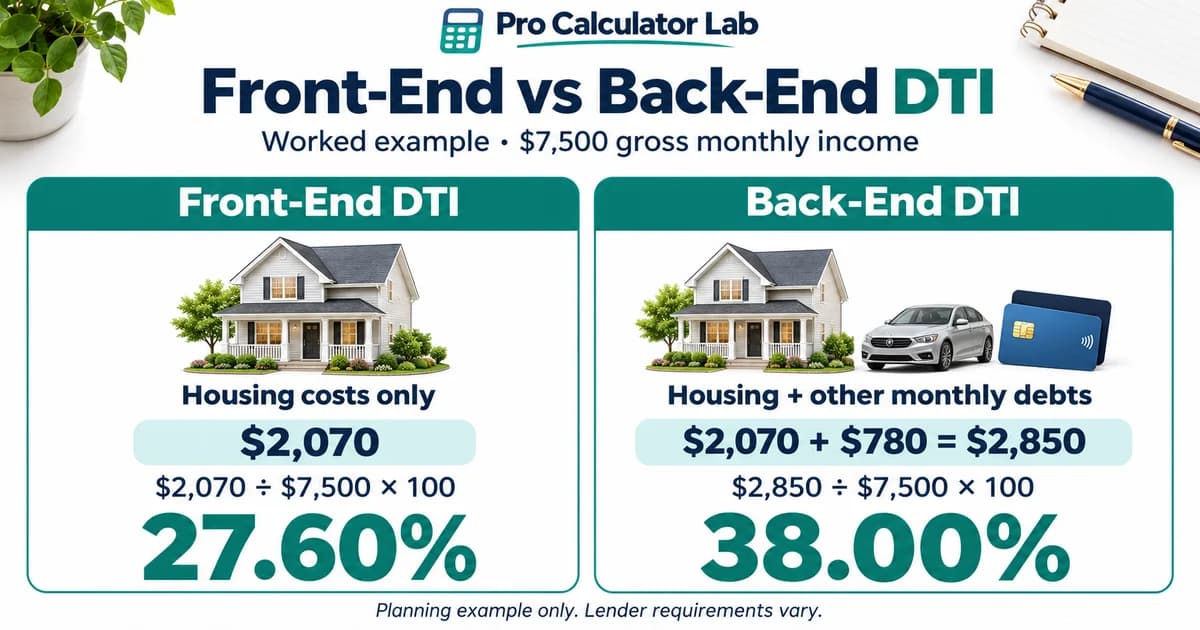
When you apply for a mortgage, lenders look at how much of your income is already committed to debt. They often do this twice: once for your housing payment alone, and once for all your debts together. These are your front-end and back-end debt-to-income ratios. Knowing both, and which one your lender cares about, tells you how much house payment you can realistically take on. Our debt-to-income ratio calculator works out both numbers in about a minute; this guide explains what they mean.
What Is the Difference Between Front-End and Back-End Ratio?
The front-end ratio compares only your monthly housing costs (mortgage principal and interest, property tax, homeowners insurance, mortgage insurance and HOA dues) with your gross monthly income. The back-end ratio adds every other monthly debt payment, such as car loans, student loans, minimum credit card payments and child support, to the same housing costs. Back-end is equal to or higher than front-end; they are equal when there are no other monthly debts.
| Comparison | Front-end ratio | Back-end ratio |
|---|---|---|
| Also called | Housing ratio, housing expense ratio, PITI ratio | Total debt ratio, DTI |
| What it counts | Housing costs only | Housing costs plus all other monthly debts |
| Common guideline | 28% or less | 36% or less |
| Who checks it | FHA and USDA; many lenders as a reference | Mortgage lenders, subject to program rules |
| What lowers it | A cheaper home, bigger down payment, lower rate, lower taxes or HOA | Everything that lowers front-end, plus paying off or avoiding other debt |
How to Calculate Your Front-End Ratio
Front-end ratio = Monthly housing costs ÷ Gross monthly income × 100Lenders use the payment on the home you are buying, not your current rent, when it replaces your rented primary residence. Retained housing obligations may still count. Include:
- Mortgage principal and interest
- Property taxes (yearly amount ÷ 12)
- Homeowners insurance (yearly premium ÷ 12)
- Mortgage insurance (PMI on a conventional loan or the FHA monthly premium)
- HOA, condo or co-op dues
Use gross income, the amount before taxes and deductions. If you are paid yearly, divide by 12.
How to Calculate Your Back-End Ratio
Back-end ratio = (Housing costs + Other monthly debts) ÷ Gross monthly income × 100Other monthly debts are the payments that show on your credit report or are required by a court order:
- Car loan or lease payments
- Student loan payments
- Minimum payments on credit cards (the minimum due, not your full balance)
- Personal loans and other installment loans
- Child support and alimony
Everyday living costs such as utilities, groceries, phone bills, car insurance and gym memberships are not included, even though they matter for your budget. Lenders may leave out an installment loan with only a few payments left, so check with your lender if you are close to a limit.
Worked Example
Sam earns $90,000 a year, or $7,500 a month before tax, and is looking at a home with these monthly costs:
| Monthly item | Amount |
|---|---|
| Mortgage principal and interest | $1,650 |
| Property tax | $300 |
| Homeowners insurance | $120 |
| Housing costs | $2,070 |
| Car loan | $450 |
| Student loan | $250 |
| Credit card minimum payments | $80 |
| Other debts | $780 |
Front-end ratio: $2,070 ÷ $7,500 = 27.6%. That is under the 28% guideline.
Back-end ratio: ($2,070 + $780) ÷ $7,500 = $2,850 ÷ $7,500 = 38.0%. That is above the 36% guideline.
Sam's housing payment on its own looks comfortable, but the car and student loans push the total over 36%. That exceeds Fannie Mae's standard 36% limit for a manually underwritten loan, though up to 45% may be permitted with the required credit score and reserves. Sam may meet the ratio requirement for Fannie Mae's automated underwriting, which permits up to 50%, and the baseline FHA 43% and VA 41% total-debt benchmarks. This does not establish loan eligibility or approval. If Sam paid off the car loan first, the back-end ratio would drop to 32.0% while the front-end ratio stayed at 27.6%.
Which Ratio Do Lenders Care About More?
For most borrowers, back-end. The cited Fannie Mae and VA guidance does not establish a separate front-end ratio limit. Individual lenders may apply additional requirements.
| Loan type | Front-end limit | Back-end limit |
|---|---|---|
| Conventional (Fannie Mae) | No separate limit in the cited guidance; lender requirements may vary | 36% standard manual; up to 45% with credit and reserve requirements; up to 50% through Desktop Underwriter |
| FHA (manual underwriting) | 31% baseline; higher when permitted | 43% baseline; higher with permitted compensating factors |
| USDA | 29% baseline; permitted exceptions apply | 41% baseline; permitted exceptions apply |
| VA | No separate limit in the cited guidance; lender requirements may vary | 41% benchmark, with residual income also checked |
Higher ratios may be permitted through automated underwriting or applicable program exceptions when the other requirements are met. Meeting a ratio requirement does not guarantee approval. For what counts as a good, acceptable or high ratio under each program, see what is a good debt-to-income ratio for a mortgage.
Passing one ratio and failing the other
Because programs check different ratios, the same borrower may meet the ratio requirement under one program but exceed another program's baseline. Suppose Jordan also earns $7,500 a month but chooses a pricier home with $2,400 in housing costs and has only $150 in other debts. Jordan's front-end ratio is 32.0% and back-end is 34.0%. That back-end ratio is within Fannie Mae's standard conventional 36% limit, but the front-end ratio is above FHA's 31% and USDA's 29% baselines. Permitted exceptions and other underwriting requirements still apply. Sam, with a lower housing cost and more debt, is the opposite.
The 28/36 Rule
The 28/36 rule is a budgeting guideline: spend no more than 28% of gross monthly income on housing and no more than 36% on all debts combined. It is not a lender requirement, but it is a useful way to find a payment that leaves room in your budget.
To use it, work out both limits and take the lower result. For Sam:
- 28% of $7,500 = $2,100 for housing
- 36% of $7,500 = $2,700, minus $780 of other debts = $1,920 for housing
The back-end limit is lower, so $1,920 is Sam's housing budget under the 28/36 rule. Whenever you carry other debts, the back-end ratio is usually what limits you. To turn a monthly budget into a home price, see how much house can I afford.
How to Lower Each Ratio
Lowering your front-end ratio
- Choose a less expensive home or make a larger down payment, which shrinks the loan and the payment.
- Put 20% down on a conventional loan to avoid PMI.
- Compare interest rates or consider buying points to lower the rate.
- Look at homes with lower property taxes or no HOA dues.
Lowering your back-end ratio
- Pay off a small loan or card balance completely, which removes the whole payment from the calculation.
- Avoid new car loans, store cards or other credit before and during the mortgage process.
- Pay down credit cards to reduce the minimum payment due.
- Add a co-borrower's income if they will be on the loan (their debts count too).
Raising your income lowers both ratios at once, but lenders generally want a stable history, so a recent raise or new job may not count in full straight away.
Frequently Asked Questions
Is DTI the same as the back-end ratio?
Usually, yes. When a lender quotes one DTI figure, it almost always means the back-end ratio, which includes housing and all other monthly debts.
Is rent included in the front-end ratio?
When you are moving from a rented primary residence into the home you are buying, the proposed home's housing costs generally replace your current rent for the mortgage assessment. Retained housing obligations may still count. If you are a renter checking your current budget, you can use your rent to see where you stand today.
What is a good front-end ratio?
28% or lower is the common guideline. FHA uses a 31% baseline for manually underwritten loans and USDA uses 29%, with permitted exceptions. The cited Fannie Mae and VA guidance does not establish a separate front-end limit, but individual lenders may apply additional requirements.
Do lenders use gross or net income?
Gross income, the amount before taxes and other deductions. That is why both ratios can look lower than your actual take-home budget.
Can my back-end ratio be lower than my front-end ratio?
No. The back-end ratio includes your housing costs plus other debts, so it is always equal to or higher than the front-end ratio. They are equal only when you have no other debts.
Sources
Fannie Mae Selling Guide B3-6-02: Debt-to-Income Ratios
HUD Handbook 4000.1: manually underwritten loan ratio requirements
eCFR: 38 CFR 36.4340, VA underwriting standards
CFPB: What is a debt-to-income ratio?
USDA HB-1-3555, Chapter 11: Ratio Analysis
Examples are for education only and are not lending advice. Lenders apply their own limits and look at your whole application.