
How Does Compound Interest Work? Simple Examples
Last reviewed:
Compound interest is the reason a savings account or investment can grow faster each year even if you never add another dollar. Instead of earning interest only on the money you put in, you also earn interest on the interest you have already received. Over a few years the effect is small. Over decades it can be the biggest part of your balance. This guide explains how compound interest works in plain terms, shows the formula, and walks through simple examples you can check yourself. To try your own numbers, use our compound interest calculator.
Compound Interest in One Sentence
Compound interest means your interest is added to your balance, and from then on that interest earns interest too, so your money grows by a larger dollar amount each period. Simple interest, by contrast, is paid only on the original amount, so it grows by the same dollar amount every year.
Here is the difference after three years on $10,000 at 6%:
| Year | Simple interest balance | Compound interest balance | Interest earned that year (compound) |
|---|---|---|---|
| 1 | $10,600 | $10,600.00 | $600.00 |
| 2 | $11,200 | $11,236.00 | $636.00 |
| 3 | $11,800 | $11,910.16 | $674.16 |
In year one they match. In year two, compound interest pays 6% on $10,600 instead of $10,000, an extra $36. That gap looks tiny, but it grows every year. For a side-by-side breakdown, see simple vs compound interest.
The Compound Interest Formula
The future value of money growing with compound interest is:
A = P × (1 + r / n)^(n × t)| Symbol | Meaning | Example |
|---|---|---|
| A | Final amount (principal plus interest) | What we are solving for |
| P | Starting amount (principal) | $10,000 |
| r | Annual interest rate as a decimal | 6% = 0.06 |
| n | Number of times interest compounds per year | 1 (yearly), 12 (monthly) |
| t | Number of years | 10 |
Worked example: $10,000 at 6% compounded once a year for 10 years is A = 10,000 × (1.06)^10 = 10,000 × 1.79085 = $17,908.48. Of that, $7,908.48 is interest. Subtract P from A any time you want the interest alone.
The displayed growth factor is rounded; the final balance and interest use the unrounded factor.
In a spreadsheet, the same result comes from =FV(0.06, 10, 0, -10000).
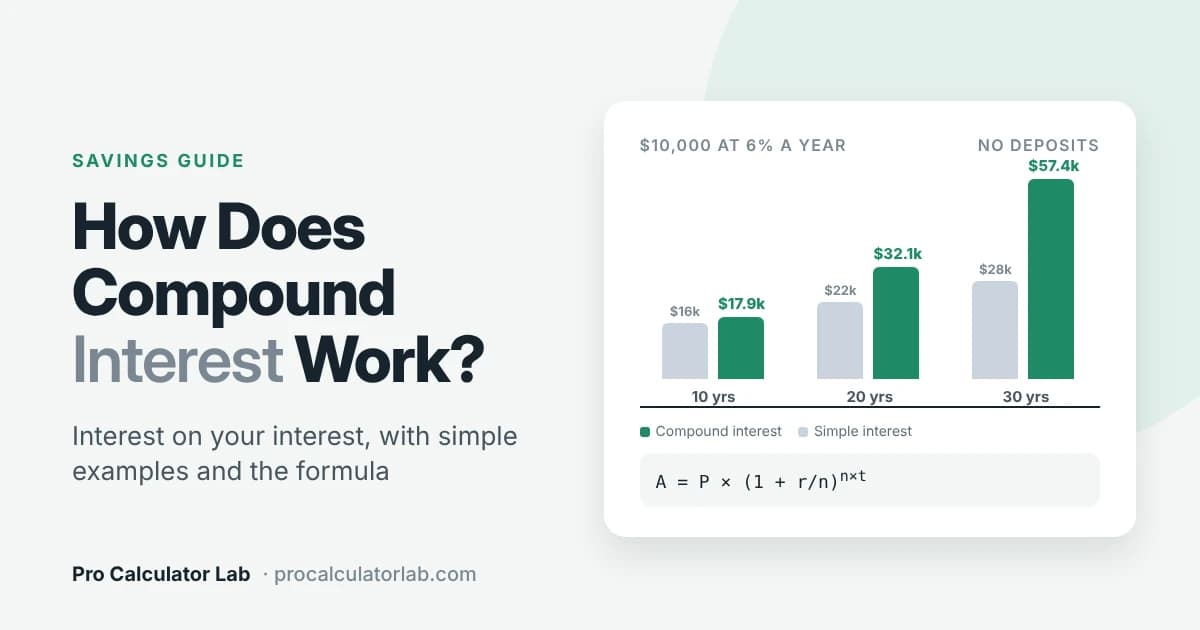
Example: $10,000 Over 10, 20 and 30 Years
Leave $10,000 alone at a steady 6% a year, compounded annually, and compare it with simple interest:
| After | Simple interest | Compound interest | Extra from compounding |
|---|---|---|---|
| 10 years | $16,000 | $17,908 | $1,908 |
| 20 years | $22,000 | $32,071 | $10,071 |
| 30 years | $28,000 | $57,435 | $29,435 |
Notice what happens between years 20 and 30. The balance grows by about $25,000 in that one decade, more than the $22,000 it gained in the first two decades combined. The interest earned in year 30 alone is $3,251, compared with $600 in year 1. That acceleration is what people mean by the power of compounding.
A quick way to estimate growth is the Rule of 72: divide 72 by the interest rate to find roughly how many years it takes money to double. At 6%, that is about 12 years. Read more in the Rule of 72.
How Compounding Frequency Changes the Result
Interest can be added yearly, quarterly, monthly or even daily. The more often it compounds, the sooner each bit of interest starts earning its own interest. Here is $10,000 at a 6% annual rate for 10 years:
| Compounding | Balance after 10 years | Effective annual yield |
|---|---|---|
| Yearly | $17,908.48 | 6.000% |
| Quarterly | $18,140.18 | 6.136% |
| Monthly | $18,193.97 | 6.168% |
| Daily (365) | $18,220.29 | 6.183% |
Moving from yearly to daily compounding adds about $312 over 10 years. It helps, but far less than a higher rate or more time. When you compare savings accounts, look at the annual percentage yield (APY), which already includes the effect of compounding, rather than the stated rate alone.
Adding Monthly Contributions
Most people do not invest one lump sum and walk away. Regular deposits get the same compounding treatment from the day they arrive, so they can add up to far more than the amount you put in.
Example: $5,000 plus $250 a month
Start with $5,000, add $250 at the end of every month, and earn 6% a year compounded monthly. After 5 years you would have $24,186.76: $20,000 of your own money and $4,186.76 of interest. This is the same example used on our calculator page, so you can check it there.
Why starting early matters
Compare two savers who each invest $200 a month at 6%, compounded monthly, until age 65:
| Saver | Starts at | Total deposited | Balance at 65 |
|---|---|---|---|
| A | Age 25 (40 years) | $96,000 | $398,298 |
| B | Age 35 (30 years) | $72,000 | $200,903 |
Saver A deposits only $24,000 more but ends with nearly twice as much, because the earlier deposits have ten extra years to compound.
Compound Interest Works Against You on Debt
Interest can also increase the cost of debt. Credit-card issuers commonly calculate interest using daily balances, while compounding methods and grace periods depend on the card agreement. Carrying a balance can lead to further interest charges, and paying more than the minimum can reduce repayment time and interest costs. Car loans and most mortgages work differently: they use a fixed payment schedule that pays off interest as you go, which you can see in our auto loan calculator and mortgage calculator.
What Compound Interest Examples Leave Out
Returns are not guaranteed. Savings accounts and certificates pay a stated rate, but investments such as stock funds rise and fall. A steady 6% is a teaching assumption, not a forecast.
Taxes and fees reduce what actually compounds. Tax-sheltered accounts may reduce or defer taxes, but fees can still reduce growth.
Inflation lowers what your future balance can buy.
Rates can change over time on variable-rate accounts.
Frequently Asked Questions
How is compound interest calculated?
Use A = P × (1 + r/n)^(n × t), where P is your starting amount, r the annual rate as a decimal, n how many times a year interest is added, and t the number of years. Subtract P from A to see the interest earned.
How much will $10,000 grow in 10 years with compound interest?
At 6% compounded yearly it grows to about $17,908; compounded monthly, about $18,194. At 4% yearly it would be about $14,802, and at 8% about $21,589.
Is daily or monthly compounding better?
Daily compounding pays slightly more than monthly at the same rate, but the difference is small: on $10,000 at 6% for 10 years it is about $26. The interest rate and how long you save matter much more.
What is the difference between APR and APY?
Loan APR expresses annual borrowing cost and can include certain fees. Savings APY reflects the effect of compounding under the account's terms. For savings, compare APYs; for loans, compare APRs alongside the fees and terms.
Do savings accounts use compound interest?
Most do. Banks and credit unions usually compound daily or monthly and pay interest monthly. Check the account's APY and compounding terms.
Sources
SEC Investor.gov: Compound Interest Calculator
SEC Investor.gov: Compound Interest glossary
CFPB: How does compound interest work?
CFPB: Credit card interest calculations
CFPB: Loan interest rate and APR
Examples use fixed illustrative rates for education only. They are not investment advice or a promise of future returns.